
 EXPLORE
Journey to Vietnam: Discovering Culture, History, Gastronomy, and Must-See Destinations
Vietnam is a destination that leaves no traveler indifferent. A long, slender country stretching like a dragon along the South China Sea, it offers a striking contrast between its grandiose natural landscapes, bustling metropolises, and peaceful villages. Organizing a trip to Vietnam means preparing for an intense sensory experience: the scent of fresh cilantro, the endless ballet of scooters, the majesty of karst peaks, and the warmth of local hospitality. This comprehensive guide explores the cultural, historical, gastronomic, and touristic treasures that make Vietnam an exceptional land in Southeast Asia.
A Millennial History Forged by Resilience
Vietnam’s history is marked by a constant struggle for independence and the preservation of its identity against powerful empires. For over a millennium, the country was under Chinese rule, a period that deeply influenced its architecture, religion (Confucianism, Taoism, and Mahayana Buddhism), and social organization. However, the Vietnamese people have always managed to preserve their ancestral customs, rooted in rice cultivation, ancestor worship, and an unwavering attachment to their native village.
In the 19th century, the arrival of the French opened a new chapter. The colonial period left a visible legacy across the country, particularly in the architecture of major cities like Hanoi and Ho Chi Minh City (Saigon). Here, you will find wide, shaded boulevards, majestic opera houses, and cathedrals that blend seamlessly into the modern urban landscape today.
Finally, recent national history is dominated by the conflicts of the 20th century—first the First Indochina War against the French, then the Vietnam War (which locals call the « American War »). The country, reunified in 1975, has shown extraordinary resilience. Today, although the scars of the past are still commemorated through sites like the Cu Chi tunnels or the Hoa Lo prison, Vietnam is resolutely looking toward the future, displaying economic dynamism and a contagious joy for life.
Vietnamese Culture: Between Tradition and Harmony
Vietnamese culture revolves around fundamental values: family, respect for elders, and the importance of « saving face » in public. Social relations are codified by respect and hierarchy, direct legacies of Confucian philosophy.
Spirituality dictates the rhythm of daily life. Even though the country is secular, beliefs intertwine. Ancestor worship is omnipresent: every home, shop, or business has a small altar where offerings (fruits, flowers, spirit money, and incense sticks) are placed to attract the goodwill of spirits.
The major cultural event is undoubtedly Tết (the Lunar New Year). It is the most important celebration on the calendar, synonymous with renewal, family reunions, hearty meals, and the observance of traditions. It is a special time when the entire country is adorned with yellow apricot blossoms in the south and pink peach blossoms in the north.
Vietnamese Gastronomy: The Subtle Balance of Flavors
Vietnamese cuisine is frequently cited as one of the best in the world. It is based on the philosophy of balancing the five fundamental tastes (sweet, salty, sour, bitter, and umami) and on the abundant use of fresh aromatic herbs, lemongrass, ginger, and the famous fermented fish sauce (nước mắm).
The gastronomy is divided into three distinct culinary regions:
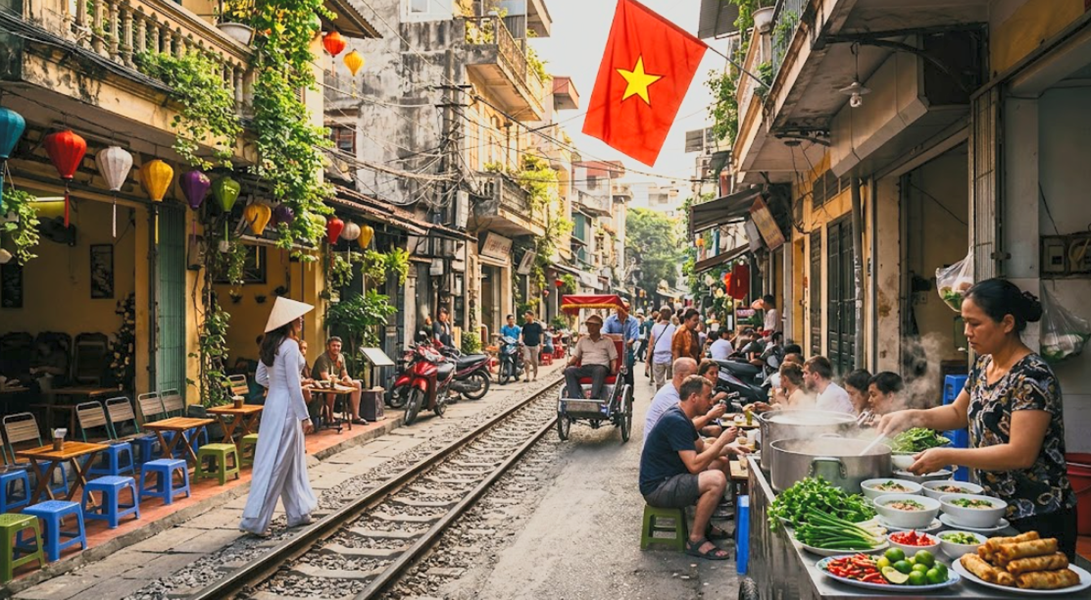
- The North (Hanoi): This is the birthplace of refined, frugal, and delicate dishes. The Chinese influence is noticeable here. The iconic dish is the famous Phở (a rice noodle soup with beef or chicken, cooked in a broth flavored with star anise and cinnamon). You can also enjoy Bún Chả, charcoal-grilled pork meatballs served with rice vermicelli, or Chả Cá, a succulent fish fried with turmeric and dill.
- The Center (Hue and Hoi An): Historically the seat of the imperial court, Central Vietnamese cuisine is renowned for its complexity, sophistication, and especially its spiciness. Bún Bò Huế, a spicy beef noodle soup flavored with lemongrass, is a culinary masterpiece. In Hoi An, it is essential to try Cao Lầu, a dish of thick noodles accompanied by roast pork and local greens.
- The South (Ho Chi Minh City and the Mekong Delta): Southern cuisine is sweeter, taking advantage of the abundance of tropical fruits, sugarcane, and coconut milk. Dishes are often served with a profusion of green leaves and fresh herbs. Here, you can savor delicious fresh spring rolls (Gỏi cuốn) and numerous stuffed rice crepes (Bánh Xèo).
Street food culture is the very soul of local gastronomy. Eating on small plastic stools on the edge of the sidewalk, amidst the honking horns, is an integral part of the Vietnamese experience. Do not miss the coffee culture, which is deeply rooted in Vietnam, notably the famous egg coffee (Cà Phê Trứng) in Hanoi, or the iced coffee with sweetened condensed milk (Cà Phê Sữa Đá).
Must-See Cities and Tourist Sites
A classic itinerary from North to South (or vice versa) allows you to appreciate the full diversity of the country. Here are the major stops you should not miss:
1. Hanoi, the Millennial Capital Located in the North, Hanoi is a city where time seems to have stood still in some places. Its Old Quarter of the « 36 Guilds » is a maze of bustling alleyways where each street is traditionally dedicated to a specific trade (silk street, iron street, medicinal herb street). Hoan Kiem Lake (Lake of the Returned Sword) offers a peaceful haven in the center of the commotion. A visit to the Temple of Literature, Vietnam’s first national university dedicated to Confucius, and the Ho Chi Minh Mausoleum is a must.
2. Halong Bay and the Northern Mountains A UNESCO World Heritage site, Halong Bay is Vietnam’s natural crown jewel. Cruising among its thousands of limestone pillars emerging from emerald waters is a magical experience. Further north, near the Chinese border, lie the mountains of Sapa and Ha Giang. Trekkers can discover terraced rice fields carved into the mountainsides and meet ethnic minorities (Hmong, Dao, Tay) who have preserved their traditional ways of life.
3. Hue, the Imperial City In the center of the country, Hue was the capital of Vietnam under the Nguyen dynasty. Traversed by the poetic Perfume River, the city is home to a magnificent Citadel and a Forbidden Purple City, inspired by Beijing’s architecture. The imperial tombs scattered in the surrounding countryside are true masterpieces of landscape architecture.
4. Hoi An, the City of Lanterns A few kilometers south of Da Nang, Hoi An is one of the most charming and best-preserved cities in the country. A flourishing former trading port from the 15th to the 19th century, its historic center (a UNESCO World Heritage site) is a beautiful blend of Vietnamese, Chinese, and Japanese architecture. You can admire the famous wooden Japanese Covered Bridge, stroll at dusk when the town is illuminated by thousands of silk lanterns, and take advantage of the countless tailors capable of making custom-made clothing in record time.
5. Ho Chi Minh City (Saigon), the Bustling Megalopolis In the South, Ho Chi Minh City is the economic heart of the country. It is a vibrant, constantly moving metropolis where ultra-modern skyscrapers stand alongside century-old pagodas and colonial buildings such as the Notre-Dame Cathedral Basilica, the Central Post Office (whose iron framework was designed by Gustave Eiffel), and the Opera House. Ben Thanh Market and the Chinatown district of Cholon are mandatory stops to feel the city’s effervescence.
6. The Mekong Delta, the Rice Bowl In the far south, the Mekong River splits into a complex labyrinth of branches and canals before flowing into the sea. This fertile, lush, and water-logged region is best explored by boat. You can observe local life organizing around the river, navigate through the heart of floating markets (like Cai Rang), and visit lush tropical orchards.
To Conclude
Visiting Vietnam means allowing yourself to be surprised at every moment. From the poetry of Halong Bay to the fervor of Saigon, passing through the tranquility of Hoi An and the captivating aromas of street food, the Land of the Dragon offers a mosaic of unforgettable experiences. Its cultural richness, backed by a complex history and a remarkably resilient people, makes it a fascinating destination. Whether you are a history buff, a food lover in search of the perfect Pho, or an adventurer seeking spectacular landscapes, Vietnam will fulfill all your expectations and leave you with imperishable memories. Pack your bags, Southeast Asia is welcoming you with open arms!

 EXPLORE
 EXPLORE