
 EXPLORE
A Beautiful Getaway to the Heart of the Netherlands: Canals, Tulips, and Dutch Charm
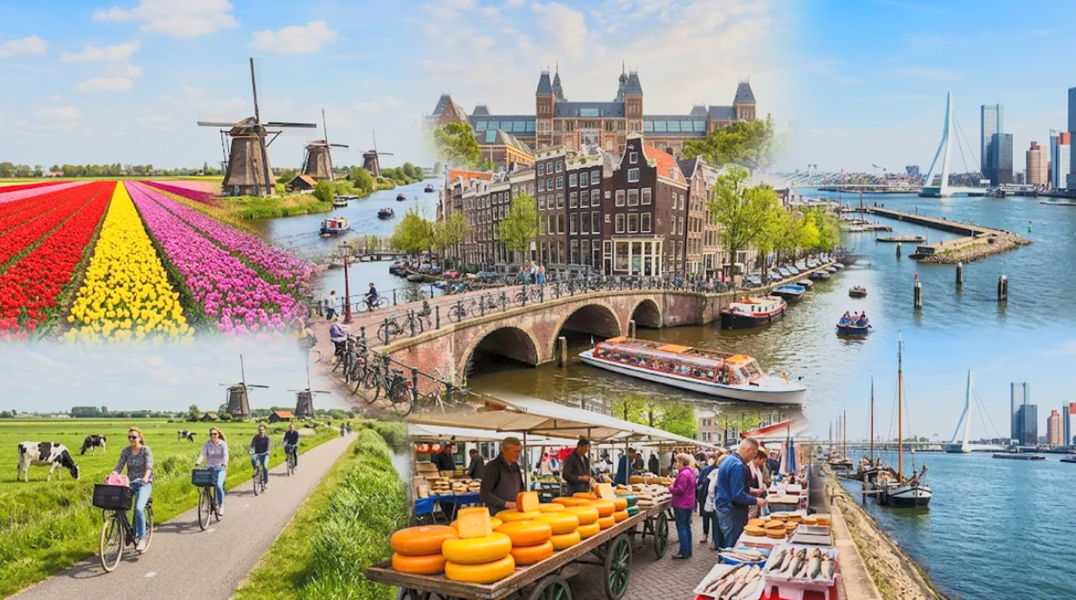
Welcome to a land where water rules, bicycles reign supreme, and every cobbled alley tells a fascinating story. The Netherlands, often boiled down to its shimmering tulip fields and iconic windmills, actually offers an infinitely richer travel experience. It is a country of striking contrasts where futuristic architecture stands shoulder-to-shoulder with elegant 17th-century buildings, and where tranquil nature meets remarkable urban vitality. Whether you are an aficionado of classical art, a lover of naval engineering, an enthusiast for bucolic walks, or an epicurean in search of new flavors, the land of polders has everything to captivate you. Let yourself be guided on an immersive journey through the heart of the Dutch lands.
A Glimpse into Dutch History: The Golden Age and Mastering the Tides
To truly appreciate your stay and understand the soul of this nation, a look back at its history is essential. The Netherlands forged its identity through a constant, ingenious struggle against the ocean. With a large portion of its territory lying below sea level, the Dutch have, over the centuries, reclaimed land from the waters through a sophisticated system of dikes, canals, and polders. The country’s hydraulic engineering is simply unrivaled.
The 17th century marked the nation’s peak: the famous Dutch Golden Age. During this era, the Republic of the Seven United Netherlands dominated world trade thanks to the formidable Dutch East India Company (VOC). This unprecedented economic prosperity yielded an exceptional artistic flourishing, led by absolute masters such as Rembrandt and Vermeer. Architecture also thrived, giving rise to the famous gabled houses along the canals, which stand today as proud remnants of this glorious past. This rich naval, commercial, and artistic legacy still deeply permeates the atmosphere of Dutch cities.
Amsterdam: The Capital of a Thousand Canals
Rightly dubbed the « Venice of the North, » the Dutch capital instantly charms visitors with an atmosphere that is both romantic and resolutely modern. Forget the car; here, exploration happens by bicycle or along the water, cruising through the Canal Ring (Grachtengordel), majestically listed as a UNESCO World Heritage site.
Your urban stroll will inevitably lead you to the Museumplein, the epicenter of Amsterdam’s cultural scene. The magnificent Rijksmuseum reigns supreme here, housing Rembrandt’s « The Night Watch, » while the neighboring Van Gogh Museum displays the world’s largest collection dedicated to the post-impressionist genius. The Anne Frank House, a deeply moving historical testament to World War II, offers a poignant and essential visit to honor the memory of Europe’s darkest hours.
For a more intimate, local vibe, lose yourself in the romantic alleyways of the Jordaan district or stroll through The Nine Streets (De 9 Straatjes). There, you will discover a wealth of vintage boutiques, independent art galleries, and cozy cafés. As night falls, the historic center—from the bustling Red Light District (De Wallen) to the lively Rembrandtplein—reveals a whole different side: vibrant, spirited, and immensely cosmopolitan.
Must-Visit Cities: Beyond the Capital
While Amsterdam captures global attention, other Dutch cities possess equally compelling identities well worth exploring during your stay.
Rotterdam: Bold Architectural Ambition
Largely destroyed by bombings during World War II, Rotterdam boldly embraced innovation and avant-garde design. Today, it stands as an open-air architectural laboratory. The spectacular Erasmus Bridge (Erasmusbrug) proudly spans the River Meuse, while architect Piet Blom’s famous Cube Houses (Kubuswoningen) literally defy gravity. Do not miss the Markthal, a futuristic, horseshoe-shaped indoor market hall whose interior vault is covered in a monumental artwork. It is a visionary, cosmopolitan port city.
The Hague: The Royal Seaside City
As the seat of the Dutch government and the residence of the royal family, The Hague (Den Haag) exudes a stately elegance. The Binnenhof—the historic political heart set beside a peaceful pond—and the renowned Peace Palace are prime examples. Art enthusiasts should on no account miss the Mauritshuis museum, an intimate gem housing Johannes Vermeer’s « Girl with a Pearl Earring. » The Hague’s great asset also lies in its direct access to the North Sea: the lively seaside resort of Scheveningen features long stretches of fine sand, relaxing beach pavilions, and a sprawling pier overlooking the waves.
Utrecht: Authentic Magic
Often considered a more tranquil alternative to the capital, Utrecht is a vibrant university city full of life. Its unique architectural hallmark? One-of-a-kind canals featuring lower-level wharves that were once used to transport goods straight into cellar storage, now transformed into highly sought-after waterside restaurant terraces. In the heart of the old town, the Dom Tower (Domtoren)—a monumental remnant of a cathedral partially destroyed by a tornado—offers breathtaking panoramas to those brave enough to climb its 465 steps.
Top Attractions and Natural Wonders
The Dutch travel experience goes far beyond cobblestone city streets. The country’s vast plains harbor remarkable wonders of nature and human ingenuity.
Keukenhof Gardens and the Magic of Tulips
If you have the chance to explore the Netherlands in spring (generally from late March to mid-May), visiting Keukenhof is an absolute must. Widely regarded as the most beautiful spring garden on Earth, it showcases millions of blooming bulbs across 32 hectares: tulips, daffodils, hyacinths, and orchids. The vibrant explosions of color form an unforgettable living canvas. In the surrounding countryside, such as the Noordoostpolder region, renting a bicycle allows you to pedal at your own pace alongside majestic flower fields stretching as far as the eye can see.
Kinderdijk and the Windmill Heritage
To capture the true essence of classic Dutch imagery, a stop at Kinderdijk in South Holland is essential. This exceptional site, rightfully listed as a UNESCO World Heritage site, features a spectacular group of 19 authentic 18th-century windmills. They were built out of necessity to drain water from the polders and protect the land from devastating floods. Strolling, cycling, or cruising along mist-shrouded canals with these wooden giants in the background offers total immersion in historical hydraulic engineering.
De Hoge Veluwe National Park
Spanning over 5,000 hectares, this park is considered the green heart of the nation. Offering hundreds of free white bicycles to visitors, it invites you to ride through an incredible mosaic of landscapes ranging from dense pine forests to mysterious heather moorlands and shifting sand dunes. Tucked away in this lush natural setting is the prestigious Kröller-Müller Museum, which boasts not only a fantastic outdoor sculpture garden but also the world’s second-largest collection of works by Vincent van Gogh.
Deep Dive into Dutch Culture: The Art of Living « Gezellig »
To understand Dutch society is to embrace a concept that defies direct translation yet defines daily life: gezelligheid. The term captures a cozy, warm, friendly, and comforting atmosphere. It is the very essence of well-being felt when sharing a beer with friends in a traditional neighborhood « brown café » (bruine kroeg)—with its dark wood interior lit by soft candlelight while raindrops drizzle against the windows.
Dutch culture is also inseparable from the bicycle. With more bikes than residents and tens of thousands of kilometers of safe, dedicated cycle paths, cycling is not merely a sport—it is a way of life. From suited lawyers to students, the entire country pedals. Embracing this eco-friendly mode of transport is the best way to experience the country like a local.
Lastly, the nation’s artistic footprint is immense. From the intimate chiaroscuro of the Dutch Golden Age masters to the bold, geometric primary lines of the De Stijl movement (exemplified by Piet Mondrian), the Dutch contribution to global creative heritage is truly monumental.
Dutch Cuisine: An Unexpected Culinary Adventure
Although Dutch gastronomy is sometimes underrated, it holds delightful surprises for those who take the time to explore it, offering a mix of winter comfort foods and exotic flavors stemming from its seafaring past.
Cheese is undeniably the starring attraction. Visiting the historical towns of Gouda or Edam means immersing yourself in centuries-old traditions. The famous Gouda cheese market—held right in front of the magnificent Gothic city hall—lets you discover an endless variety of wheels ranging from young cheese to aged (oude kaas), often seasoned with cumin, pesto, or cloves.
On the savory side, the bitterbal (commonly served as a plate of bitterballen) is the quintessential bar snack. These crispy-on-the-outside, creamy-on-the-inside deep-fried beef ragout bites are meant for dipping in sweet mustard. Adventurous foodies visiting in spring can sample Hollandse Nieuwe—raw herring traditionally eaten by holding it by the tail, topped with finely diced onions.
However, sweet treats are where the Netherlands truly shines. The iconic stroopwafel—a thin waffle sliced horizontally and filled with warm, gooey caramel syrup—is an absolute must-try (the secret recipe at Kamphuisen in Gouda is particularly famous). You will also love poffertjes: miniature, fluffy pancakes dusted generously with powdered sugar and topped with melted butter.
Additionally, Dutch colonial history has greatly enriched the country’s dining table. Indonesian cuisine is omnipresent, and the Rijsttafel (literally « rice table »)—an incredible feast featuring dozens of small, aromatic, and spicy dishes shared family-style—has become an essential local institution.
The Call of the Low Countries
To travel through the Netherlands is to embrace a way of life where progress and modernity never eclipse a deep respect for heritage and nature. From the winding, romantic canals of Amsterdam to the striking architectural ambitions of Rotterdam, from the fleeting sea of colors at Keukenhof to the serene quiet of the polders watched over by the windmills of Kinderdijk, every corner evokes a unique emotion. The country invites you to slow down, breathe in the sea air, and marvel at humanity’s ingenious adaptation to its environment. Set out for this captivating destination that promises unforgettable memories. Goede reis!

 Buy on Amazon FR


 EXPLORE
 EXPLORE
 EXPLORE
 EXPLORE