
 EXPLORE
Visiting Norway: The Guide to Majestic Fjords, Vibrant Cities, and the Nordic Way of Life
A long ribbon of granite carved by glaciers and bordered by the frigid waters of the North Atlantic and the Barents Sea, Norway exerts an immediate fascination on travelers in search of authenticity. From sheer peaks plunging into emerald sea inlets to the blood-red stilt fishermen’s cabins of the Lofoten Islands, this Scandinavian gem goes far beyond a mere postcard backdrop. A true laboratory of the future when it comes to ecology, a hotspot for contemporary architecture, and a rising star on the global culinary scene, the land of the ancient Vikings offers a rare harmony between urban modernity and untamed wilderness. Whether you dream of chasing the Northern Lights beyond the Arctic Circle or strolling through avant-garde design museums, planning a trip to Norway promises an extraordinary sensory immersion.
Why Visit Norway? The Reasons Behind a Timeless Appeal
Choosing Norway as a vacation destination means, above all, treating yourself to the luxury of space, silence, and light. The country is governed by a fascinating celestial duality that radically transforms the travel experience depending on the season. From May to July, the midnight sun bathes the north of the country in perpetual golden light, blurring the boundaries between day and night and supercharging hikers’ energy. Conversely, from September to March, the polar night drapes the land in darkness, providing an immaculate canvas for the magnetic ballet of the aurora borealis—those green and violet curtains dancing across the Arctic sky.
Beyond astronomical phenomena, a stay on Norwegian soil reassures and soothes. Consistently ranked among the happiest and safest nations on the planet, Norway cultivates a sincere and understated hospitality. Its road, rail, and maritime infrastructures are remarkably reliable, seamlessly connecting even the most isolated villages. Furthermore, the national commitment to the eighteen Norwegian Scenic Routes—panoramic drives lined with rest areas and viewpoints designed by leading Scandinavian architects—turns every car or train journey into an open-air art exhibition.
Must-Visit Cities in Norway: Between Modernity and Historical Heritage
Far from being mere transit hubs on the way to the great outdoors, Norwegian cities each boast a distinct architectural and cultural identity, all intimately tied to the surrounding sea and mountains.
Oslo, the Green and Avant-Garde Capital
Nestled at the head of its eponymous fjord and encircled by the dense forests of the Marka, Oslo has undergone a spectacular architectural metamorphosis. The former industrial waterfront has given way to vibrant pedestrian districts like Bjørvika and Tjuvholmen. Visitors can literally walk up the sloping white marble roof of the Oslo Opera House, a masterpiece by the firm Snøhetta that appears to rise straight out of the water. Right next door, the contemporary silhouette of the MUNCH museum dialogues with the new National Museum, the largest art space in the Nordic countries. To feel the pulse of the local lifestyle, simply stroll along the quays at sunset, where locals alternate between the intense heat of floating wooden saunas and an invigorating plunge into the icy waters of the fjord, summer and winter alike.
Bergen, the Hanseatic City and Gateway to the Fjords
Surrounded by seven mountains on the west coast, Bergen immediately charms visitors with its maritime atmosphere and centuries-old history. Its beating heart remains Bryggen, the old Hanseatic League merchants’ wharf listed as a UNESCO World Heritage site. Its colorful wooden houses with pointed gables, leaning under the weight of the centuries, house artisan workshops, ceramicists, and intimate galleries. To take in the city’s jagged geography at a glance, riding the Fløibanen funicular up to the summit of Mount Fløyen in just a few minutes is an essential ritual before heading back down to wander the cobblestone alleys of the Nordnes neighborhood.
Tromsø, the Vibrant Capital of the Arctic
Located 350 kilometers (217 miles) north of the Arctic Circle, Tromsø defies every cliché of isolation associated with high latitudes. Set on an island ringed by snow-capped alpine peaks, this university town buzzes with cultural energy and nightlife. Dominated by the bold triangular lines of its Arctic Cathedral, it serves as the premier base for winter dog-sledding expeditions, whale-watching tours to spot humpbacks and orcas in neighboring fjords, and Northern Lights hunts.
Trondheim and Ålesund, Jewels of History and Architecture
In central Norway, Trondheim—the kingdom’s first historical capital—captivates visitors with the majesty of its Gothic Nidaros Cathedral, Norway’s national sanctuary. Its old stilt warehouses lining the Nidelva River and its picturesque Bakklandet district, home to the world’s first bicycle lift, make it an effortlessly charming stop. Further southwest, the port city of Ålesund presents a face unique in Europe: completely destroyed by a fire in 1904, it was rebuilt within a few years in a flamboyant Art Nouveau style, dotted with turrets, spires, and medieval or neo-Viking ornaments reflected in its canals.
Culture and Way of Life: The Deep Soul of the Norwegian People
Understanding Norway requires immersing yourself in the cultural concepts that have governed the daily lives of its inhabitants for generations.
- Friluftsliv (Open-Air Living): Far more than a simple pastime, this national philosophy holds that human well-being stems from regular, respectful contact with nature, regardless of the weather. A local proverb sums up this mindset perfectly: « There is no such thing as bad weather, only bad clothing. »
- Allemannsretten (The Right to Roam): Enshrined in Norwegian law, this fundamental right allows any traveler to walk freely and pitch a tent for up to 48 hours on any uncultivated land, provided they stay at least 150 meters away from the nearest inhabited house or cabin and leave no trace behind.
- Kos: The Norwegian equivalent of Danish hygge, kos refers to the constant pursuit of human warmth, comfort, and conviviality, embodied by candlelight flickering from mid-afternoon onward, crackling fireplaces in mountain cabins (hytte), and coffee breaks shared with friends.
- Viking Heritage and Stave Churches: The country’s maritime and medieval past reveals itself through the impressive Stavkirker (stave churches) dating from the 12th and 13th centuries, such as those in Borgund or Heddal. Built without a single nail using Viking shipbuilding techniques, they blend Christian symbols with pagan dragon heads.
- Indigenous Sami Culture: In the Far North (the Finnmark region, notably in Karasjok and Kautokeino), the Sami people perpetuate an ancestral semi-nomadic way of life centered on reindeer herding, antler and wood craftsmanship (duodji), and joik, a traditional guttural chant recognized as one of the oldest forms of musical expression in Europe.
Sustainable Development and Ecology: An Inspiring Global Model
In a fascinating paradox of modern economics, Norway has harnessed the historical revenues from its offshore resources—managed within the largest sovereign wealth fund on the planet—to finance the most advanced ecological transition in the world. For contemporary travelers mindful of their carbon footprint, the country offers an exemplary tourism ecosystem. Nearly all the electricity consumed across the territory comes from renewable hydroelectric power, generated by countless waterfalls and mountain dams.
This clean energy powers an unrivaled green mobility network. On the streets of Oslo or Bergen, silence reigns: private cars, buses, and taxis are now overwhelmingly electric. This revolution extends to the waterways as well. The famous ferries cruising the UNESCO-listed fjords run on electric batteries or silent hybrid systems, eliminating diesel fumes and noise pollution to preserve the tranquility of marine wildlife and towering cliffs. The government has also established the rigorous « Sustainable Destination » label, certifying tourist regions (such as Røros, Trysil, or the Vega Islands) that make concrete commitments to waste reduction, supporting local economies, and protecting biodiversity.
Norwegian Gastronomy: Putting the Arctic Terroir in the Spotlight
Long unfairly dismissed as an austere subsistence cuisine, Norwegian gastronomy is experiencing a true golden age, propelled by the New Nordic Cuisine movement and a shower of Michelin stars (featuring world-renowned restaurants like Maaemo in Oslo and Re-Naa in Stavanger). The secret behind this success lies in the exceptional purity of raw ingredients: slow-growing, icy waters give seafood a firm, flavorful flesh, while the continuous sunshine of the boreal summer concentrates natural sugars in wild berries and root vegetables.
On a culinary journey through Norway, several local specialties deserve careful tasting:
- Treasures of the Cold Sea: Beyond the quintessential smoked or dill-cured salmon (gravlaks), winter is the peak season for Skrei, a migratory Arctic cod prized for its pearly, remarkably delicate flesh. In the Far North, catching and feasting on gigantic red king crab from the Barents Sea makes for an unforgettable gastronomic experience, as do hand-dived scallops harvested from the waters off Trondheim.
- Brunost (Brown Cheese): A true national institution found on every breakfast table, this brown cheese made from reduced whey of cow’s and goat’s milk surprises newcomers with its fudgy texture and sweet, salted-caramel flavor. It is enjoyed thinly sliced using a cheese slicer (a Norwegian invention) atop crisp flatbread or warm heart-shaped waffles.
- Game Meats and Fårikål: Forests and tundras yield lean, aromatic reindeer, moose (elk), and venison, often served with lingonberry and juniper sauces. Autumn celebrates Fårikål, the official national dish consisting of mutton slow-cooked with cabbage and whole black peppercorns.
- Coffee Culture and Cardamom Pastries: As the second-largest coffee consumers per capita in the world, Norwegians have elevated light roasting to an art form, particularly in Oslo, home to some of the finest baristas on the planet. This coffee break is invariably paired with a Skillingsbolle (a cinnamon roll iconic to Bergen) or a braided bun fragrant with freshly ground cardamom.
Must-See Natural Landmarks to Add to Your Itinerary
Norway’s geography is a succession of natural monuments sculpted on a colossal scale. To structure a balanced itinerary, five major sites stand out as essential stops.
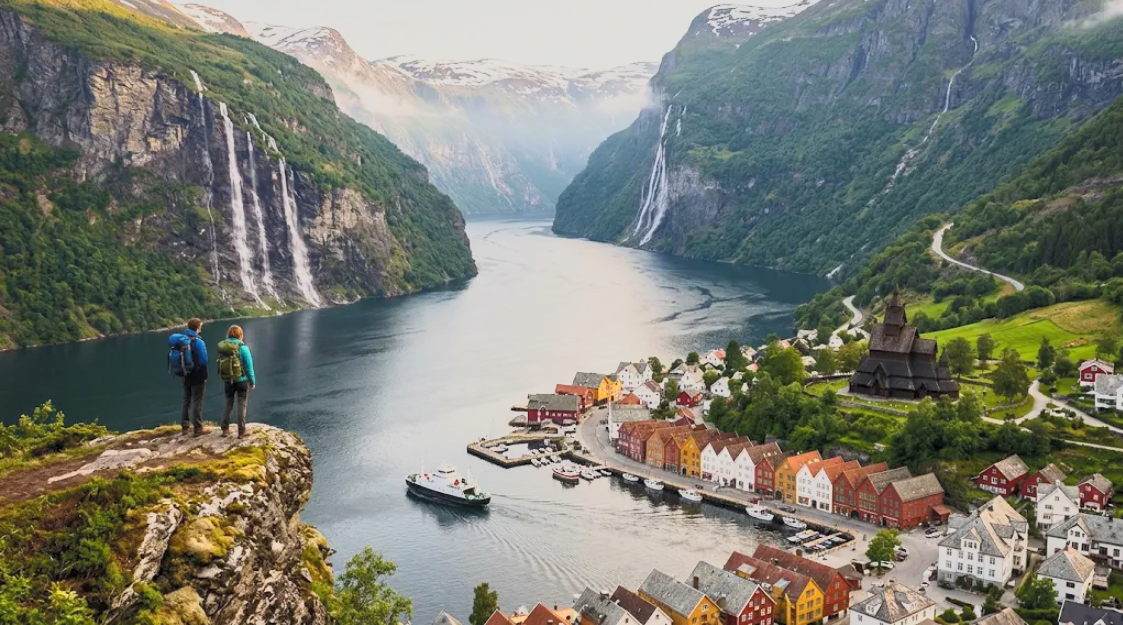
- The Geirangerfjord and Nærøyfjord: Jointly inscribed as UNESCO World Heritage sites, these two jewels epitomize the archetypal Norwegian fjord. The Geirangerfjord dazzles with vertical rock walls pierced by dizzying waterfalls like the « Seven Sisters, » while the Nærøyfjord—an arm of the massive Sognefjord—astounds with its dramatic narrowness, measuring no more than 250 meters wide in places beneath cliffs soaring over 1,700 meters high.
- The Lofoten Archipelago: Rising straight out of the ocean like a jagged alpine wall north of the Arctic Circle, the Lofoten Islands offer one of the most photogenic panoramas on Earth. In villages like Reine, Hamnøy, and Henningsvær, traditional stilt fishermen’s cabins (rorbuer) stand alongside centuries-old cod-drying racks and white-sand beaches lapped by turquoise waters like Haukland, favored by Arctic surfers.
- Iconic Hikes (Preikestolen and Trolltunga): In the Stavanger region, Preikestolen (Pulpit Rock) is a flat-topped granite cliff towering 604 meters vertically above the Lysefjord. More demanding, the hike to Trolltunga (Troll’s Tongue) rewards seasoned trekkers with a horizontal rock sliver jutting out 700 meters above the deep blue waters of Lake Ringedalsvatnet.
- The Flåm Railway (Flåmsbana) and Trollstigen: To admire the dramatic relief without physical exertion, the Flåm train offers one of the steepest standard-gauge railway journeys in the world, climbing 20 kilometers from the shores of the Aurlandsfjord to the snow-dusted high plateau of Myrdal through spiral tunnels and dramatic gorges. By road, the eleven hairpin bends of Trollstigen (the Troll’s Path), carved into a sheer mountainside amid cascading waterfalls, represent a triumph of road engineering.
- The North Cape and the Svalbard Archipelago: At the very end of European route E69, the slate plateau of the North Cape (Nordkapp), rising 307 meters above the Arctic Ocean, symbolically marks the northernmost tip of continental Europe. For adventurers drawn to extremes, a flight to Svalbard (Spitsbergen), halfway between mainland Norway and the North Pole, opens the gates to the realm of pack ice, colossal glaciers, and polar bears.
Planning a trip to Norway means agreeing to slow down and let yourself be swept away by the sheer scale of the elements. Whether gliding silently through the heart of a millennia-old fjord, sharing a Michelin-starred meal showcasing the local catch of the day, or gazing out at the Arctic horizon from a designer wooden cabin, the country leaves a lasting imprint on every visitor’s mind—invariably sparking the desire to return in another season.

 Acheter sur Amazon FR


 EXPLORE
 EXPLORE
 EXPLORE
 EXPLORE