
 EXPLORE
Discovering the Magic of India: A Tapestry of Culture, Heritage, and Modern Wonders
India is a land of staggering contrasts, vibrant colors, and profound historical depth. As one of the world’s oldest living civilizations, this South Asian powerhouse invites travelers into a mesmerizing mosaic where ancient traditions seamlessly blend with a rapidly modernizing society. Stretching from the soaring, snow-capped peaks of the Himalayas down to the sun-drenched tropical coasts of the Indian Ocean, India offers a transformative journey for anyone seeking a deeper connection with history, spirituality, and diverse cultural expressions.
A Rich Tapestry of Populations and Languages
Home to over 1.4 billion people, India is the world’s most populous nation, characterized by an extraordinary demographic variety. Its population comprises hundreds of ethnic groups, linguistic communities, and indigenous tribal populations, often referred to as Adivasis, who preserve ancestral ways of life.
Linguistically, India is a breathtaking federation of voices. The country recognizes 22 major scheduled languages, with Hindi and English serving as official mediums for national governance and business. However, regional pride shines through distinct tongues such as Bengali, Tamil, Telugu, Marathi, Gujarati, and Punjabi. Each linguistic region possesses its own distinct literature, cinema, and folklore, ensuring that traveling across state borders feels akin to crossing through several distinct countries within a single national boundary.
Religions, Cults, and Living Spiritual Traditions
Religion in India is not merely a set of beliefs; it is an immersive, daily way of life that dictates rhythms, cuisine, art, and celebration. As the birthplace of four major world religions—Hinduism, Buddhism, Jainism, and Sikhism—India has long been a sanctuary for profound philosophical inquiry.
Hinduism, practiced by the majority of the population, is visible in the endless shrines, household altars, and massive temple complexes that punctuate the landscape. Pilgrimage remains central to the Indian spiritual experience, with millions traveling annually to sacred sites along the holy rivers, mountains, and ancient temple corridors.
Islam is the nation’s largest minority religion, leaving an indelible architectural and cultural legacy through magnificent mosques, Sufi shrines, and culinary traditions. Christianity, introduced early in the nation’s history, thrives particularly in the southern states like Kerala and Goa, blending western ecclesiastical architecture with indigenous practices.
Sikhism, founded in the Punjab region, emphasizes egalitarianism, community service, and devotion, epitomized by the radiant Golden Temple in Amritsar, where free meals are served daily to hundreds of thousands of visitors regardless of background. Buddhism and Jainism, both originating as ascetic movements against rigid ritualism, emphasize non-violence, mindfulness, and inner peace, drawing seekers to monastic centers across the northern and eastern belts.
Iconic Tourist Destinations and Major Cities
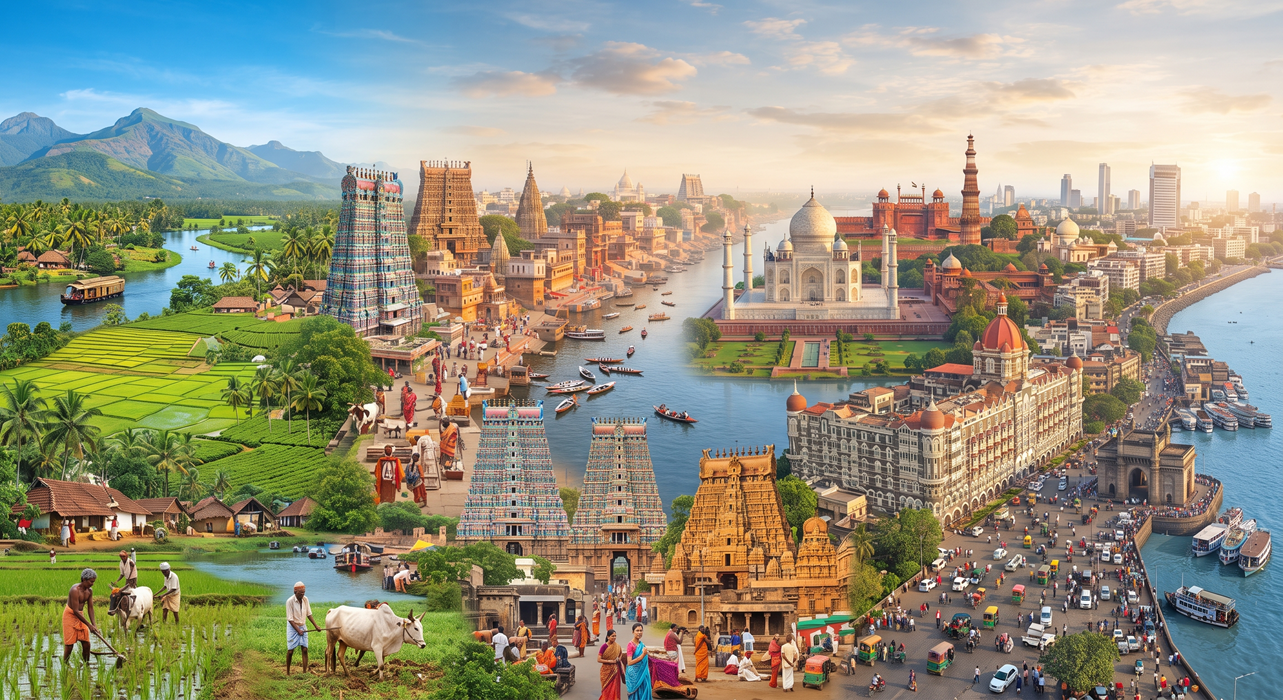
India’s tourism landscape is vast, traditionally anchored by the famous Golden Triangle route linking Delhi, Agra, and Jaipur.
- Delhi: The sprawling capital serves as a microcosm of the nation, juxtaposing the medieval labyrinth of Old Delhi’s street markets and the majestic Red Fort with the wide, colonial avenues and government buildings of New Delhi. Monuments like Qutb Minar and Humayun’s Tomb showcase centuries of shifting architectural mastery.
- Agra: Located in Uttar Pradesh, Agra is globally celebrated for the Taj Mahal, an architectural masterpiece of white marble built by the Mughal Emperor Shah Jahan as a monument of eternal love. Beyond the Taj, Agra Fort offers deep insights into imperial history.
- Jaipur: Known as the Pink City, Rajasthan’s capital enchants visitors with hilltop fortresses like Amer Fort, ornate royal residences such as the City Palace, and the intricate honeycomb facade of Hawa Mahal.
- Varanasi: Situated on the banks of the sacred Ganges River, Varanasi is one of the world’s oldest continually inhabited cities. Pilgrims gather along its stone ghats to perform morning prayers and witness the mesmerizing evening Ganga Aarti ceremony, an unforgettable spectacle of fire, chant, and devotion.
- Mumbai: India’s financial powerhouse and the heart of the Bollywood film industry, Mumbai pulses with relentless energy. From the colonial grandeur of the Gateway of India and Victoria Terminus to the bustling seaside promenades of Marine Drive, the city represents modern commercial ambition.
- Kolkata: Revered as the cultural and intellectual capital of the east, Kolkata boasts colonial-era architecture, vibrant literary hubs, and legendary artistic communities.
- Southern Escapes: Further south, the tranquil backwaters of Kerala offer serene houseboat cruises amidst emerald palm groves, while Tamil Nadu stuns travelers with towering, vividly sculpted Dravidian temple architecture in cities like Madurai and Thanjavur.
Culinary Specialties: A Symphony of Spices
Indian cuisine is globally renowned for its sophisticated use of spices, aromatic herbs, dairy, and regional vegetables. Because dietary preferences vary widely due to religious traditions—such as vegetarianism practiced by large segments of the Hindu, Jain, and Buddhist populations—the variety of plant-based dishes is unmatched.
Northern cuisine leans heavily on rich, dairy-based gravies, wheat flatbreads like naan and roti, and clay-oven tandoori specialties. In contrast, southern cooking relies on rice, lentils, coconut, and tamarind, producing staples like fermented dosas, idlis, and fiery fish curries. Coastal regions specialize in seafood seasoned with mustard seeds, curry leaves, and coastal chilies, while street food culture—ranging from spicy potato-filled chaats to crispy golgappas—tempts adventurous palates across every major urban center.
Culture, Arts, and Performing Traditions
The cultural heritage of India finds expression in its classical and folk arts, which have been nurtured and handed down through generations.
Classical dance forms—such as Bharatanatyam from Tamil Nadu, Kathak from the north, Odissi from Odisha, and Kathakali from Kerala—tell mythological stories through intricate hand gestures, facial expressions, and rhythmic footwork. Classical music, divided into the Hindustani tradition of the north and the Carnatic tradition of the south, relies on melodic modes known as ragas and complex rhythmic cycles known as talas, often featuring instruments like the sitar, tabla, and flute.
Visual arts and crafts are equally diverse. Handloom weaving produces exquisite textiles, from Banarasi silk sarees in Uttar Pradesh to Kanjeevaram silks in the south and intricate block prints in Rajasthan. Pottery, metalwork, woodcarving, and traditional painting styles like Madhubani and Miniature art reflect an enduring reverence for craftsmanship and aesthetic beauty.
Conclusion
A journey through India is much more than a standard vacation; it is an awakening of the senses and a profound education in human resilience, spirituality, and artistic expression. Whether you are finding inner peace during a yoga retreat in Rishikesh, marveling at the marble symmetry of the Taj Mahal, or sharing a meal inside a community kitchen, India offers a welcoming embrace that leaves an indelible mark on every traveler’s soul.

 EXPLORE
 FOOD
 EXPLORE
 EXPLORE