
 EXPLORE
Travel to the United Arab Emirates: Between Mystical Desert and Spectacular Futurism
Planning a trip to the United Arab Emirates means immersing yourself in a land of striking contrasts, where the ochre dunes of the Arabian Desert meet the most daring skyscrapers on the planet. Located at the crossroads of East and West, along the turquoise waters of the Persian Gulf and the Gulf of Oman, this federation of seven emirates has established itself as one of the world’s most sought-after tourist destinations.
Far from being limited to the glitz and extravagant luxury often highlighted on social media, the country holds a deep cultural richness, ancestral hospitality, and an unexpected diversity of landscapes. Whether you are seeking adrenaline, contemporary art, a seaside getaway, or historical authenticity, a stay in the United Arab Emirates promises an extraordinary experience.
Why Visit the United Arab Emirates? The Assets of a Unique Destination
Choosing to travel to the United Arab Emirates caters to a wide range of travelers, from curious backpackers to families and lovers of grand luxury hotels. Several major factors explain this popularity:
- Guaranteed sunshine: With a subtropical desert climate, the country enjoys blue skies all year round. The ideal time to visit runs from October to April, when temperatures hover pleasantly between 24°C and 30°C (75°F to 86°F), offering a perfect escape from the European or North American winter.
- Absolute safety: Emirati cities regularly top global rankings of the safest metropolises. You can travel with complete peace of mind, day or night, whether traveling solo, as a couple, or with young children.
- Stunning geographical diversity: In less than two hours by road, you can leave a white sandy beach lined with high-rises, cross the giant dunes of the Rub’ al Khali, and climb the rocky peaks of the Hajar Mountains.
- World-class infrastructure: Direct flight connections from major global capitals, an impeccable road network, an automated metro system, and hospitality excellence make traveling smooth and hassle-free.
From Sand to Stars: The Dazzling Development of the Federation
Understanding the soul of the Emirates requires looking at its recent history—a true economic and architectural miracle. Before the unification of the seven emirates on December 2, 1971, under the visionary leadership of Sheikh Zayed bin Sultan Al Nahyan, the region lived mainly off maritime trade, camel herding, date cultivation, and above all, pearl diving.
The discovery of oil in the late 1950s and early 1960s acted as an exceptional catalyst. Rather than relying solely on this energy windfall, the leaders invested heavily in infrastructure, education, finance, and tourism to prepare for the post-oil era.
Within half a century, former fishing villages transformed into laboratories of futuristic urban planning. This dizzying development is focused on ecological transition, artificial intelligence, and renewable energy, while making sure never to erase the tribal roots that cement the national identity.
Major Cities and the Seven Emirates to Explore
While Dubai and Abu Dhabi attract most of the spotlight, each emirate has its own personality and deserves attention during a United Arab Emirates itinerary.
Dubai: The Metropolis of Superlatives
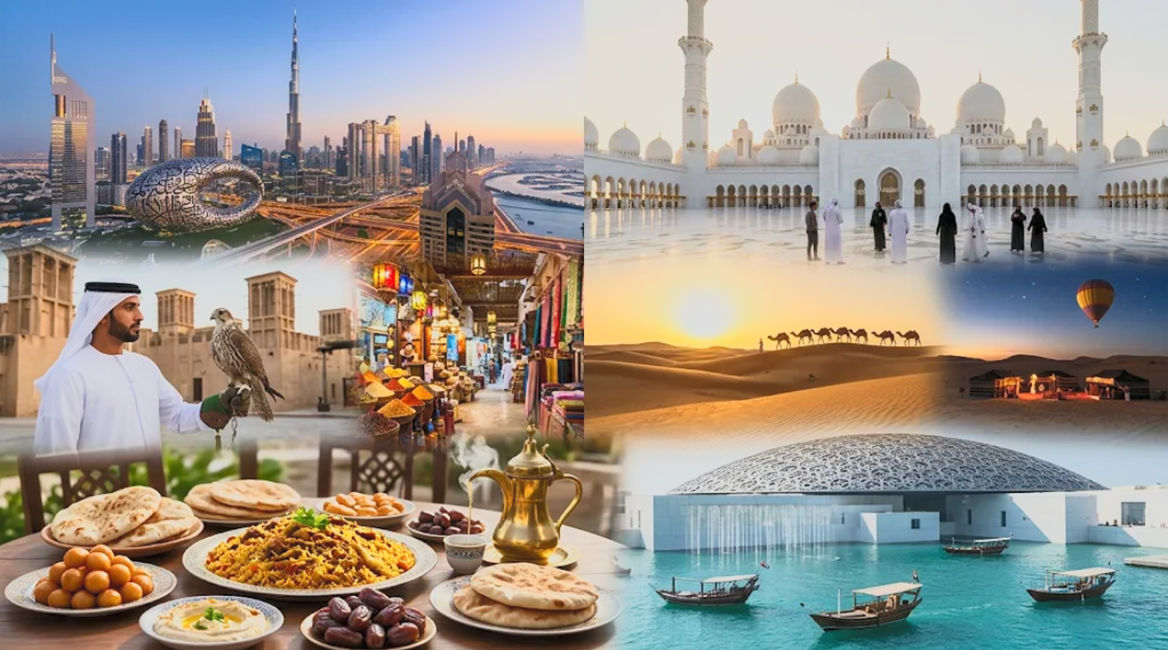
A true tourist magnet, visiting Dubai feels like traveling into the future. It is the city of architectural excess, embodied by its palm-shaped artificial islands (Palm Jumeirah) and its glittering skyline along Sheikh Zayed Road. Yet Dubai has managed to preserve its historic heart around the Creek (Khor Dubai). In the sandy alleys of Al Fahidi (Bastakiya), traditional houses topped with wind towers (barjeels) sit alongside the bustling souks of Deira and Bur Dubai, reached aboard an abra, the traditional wooden water taxi.
Abu Dhabi: The Majestic Cultural Capital
Larger and more laid-back than its neighbor, Abu Dhabi cultivates an institutional and cultural elegance. Built on an archipelago of natural islands bordered by lush mangroves, the federal capital charms visitors with its immaculate Corniche and its ambitious cultural district on Saadiyat Island. An hour and a half inland, the garden city of Al Ain, birthplace of the ruling family, reveals lush palm groves irrigated by the ancestral falaj system, listed as a UNESCO World Heritage site.
Sharjah: The Bastion of Arts and Traditions
Located just north of Dubai, the emirate of Sharjah was designated the Cultural Capital of the Arab World by UNESCO. It is the ideal place for travelers seeking authenticity. Its restored heritage district (Heart of Sharjah), its exceptional Museum of Islamic Civilization, and its contemporary art foundations offer an intellectual and aesthetic immersion far from commercial hustle and bustle.
Ras Al Khaimah and Fujairah: The Call of Nature, Between Mountains and Ocean
For outdoor enthusiasts, the north and east of the country offer magnificent playgrounds. Ras Al Khaimah is home to Jebel Jais, the highest peak in the UAE at over 1,900 meters (6,200 feet), renowned for its dizzying hiking trails and the world’s longest zipline. Meanwhile, Fujairah, the only emirate facing entirely onto the Gulf of Oman and the Indian Ocean, attracts scuba diving and snorkeling enthusiasts thanks to its preserved coral reefs around Snoopy Island. Finally, the smaller emirates of Ajman and Umm Al Quwain offer a peaceful coastal atmosphere and wild lagoons ideal for kayaking.
Emirati Culture and Traditions: The Preserved Bedouin Soul
Behind the glass and steel facades beats the heart of a society deeply attached to its Bedouin values and the Islamic faith. Although more than 85% of the resident population consists of expatriates from two hundred different countries, Emirati culture remains the foundation of daily life.
This identity is expressed first and foremost through traditional dress, worn with pride: the kandura (or dishdasha), an immaculate long white robe for men, accompanied by the ghutra (headscarf) held in place by the agal (black cord), and the black abaya, often finely embroidered, for women.
At the center of social relations sits the notion of karam (generosity and hospitality). Welcoming a visitor into the majlis (the traditional sitting room) over gahwa—light Arab coffee infused with cardamom and saffron, served in small handleless cups (finjan) with sweet dates—is a sacred ritual inscribed on UNESCO’s Intangible Cultural Heritage list.
Ancestral passions still set the pace of the year:
- Falconry: Once essential for hunting in the desert, it has become a national symbol. Falcons even have their own passports and a world-renowned dedicated hospital in Abu Dhabi.
- Camel racing: Very popular in winter, these races blend centuries-old tradition with high technology, as the animals are ridden by tiny remote-controlled robot jockeys operated by owners following the race in 4×4 vehicles.
- Nabati poetry and Al-Ayyala dance: These oral and choreographic arts celebrate honor, bravery, and tribal cohesion during weddings and national holidays.
Must-See Attractions in the United Arab Emirates
To make the most of your tour of the United Arab Emirates, certain monuments and natural sites stand out as essential stops:
- Sheikh Zayed Grand Mosque in Abu Dhabi: An absolute masterpiece of neo-Islamic architecture, this dazzling white structure features 82 marble domes, over a thousand columns inlaid with semi-precious stones, monumental gilded chandeliers, and the world’s largest hand-knotted carpet. At sunset, its reflective pools offer a magical spectacle.
- Burj Khalifa and Downtown Dubai: Standing at 828 meters (2,716 feet), the tallest tower in the world dominates a vibrant district where visitors admire the aquatic and musical choreography of the Dubai Fountain as well as the gigantic Dubai Mall.
- Louvre Abu Dhabi: Designed by French architect Jean Nouvel on Saadiyat Island, this universal museum is topped by a 180-meter-wide openwork metal dome that lets through a poetic « rain of light, » inspired by local palm groves.
- Museum of the Future in Dubai: Recognizable by its torus shape covered in stainless steel Arabic calligraphy, this column-free building offers an immersive exploration of technology and ecology looking ahead to the year 2071.
- Liwa Desert and Al Marmoom Oasis: It is impossible to leave the country without venturing into the dunes. Liwa, at the gateway to the Rub’ al Khali desert (the Empty Quarter), reveals red sand dunes rising over 300 meters high, while the Al Marmoom reserve allows you to spot herds of Arabian oryx roaming free.
- The Mountain Enclave of Hatta: Part of Dubai but nestled in the heart of the Hajar Mountains, Hatta charms visitors with its emerald-blue artificial lake surrounded by dark mountains, ideal for kayaking, mountain biking, and visiting its restored heritage village.
- Qasr Al Watan: The presidential palace in Abu Dhabi opens its doors to visitors to showcase the splendor of contemporary Arab craftsmanship through its soaring domes and geometric mosaics.
Emirati Gastronomy: A Sensory Journey Scented with Spices
Long overlooked in the face of the plethora of Michelin-starred international restaurants, United Arab Emirates gastronomy is experiencing a true revival. Influenced by the trade routes of Persia, India, and East Africa, traditional cuisine highlights a subtle blend of spices called bzar (cardamom, cinnamon, turmeric, coriander, cloves, and black pepper).
Among the local specialties you must try:
- Machboos: The quintessential national dish, consisting of basmati rice slowly simmered with lamb, chicken, or fish, flavored with saffron and loomi (dried black lime that brings a unique tangy and smoky note).
- Harees: A comforting dish made of cracked wheat and lamb or chicken meat, cooked slowly for hours until it reaches a melting, velvety texture—a staple during the month of Ramadan and major celebrations.
- Thareed: A rich stew of meat and seasonal vegetables served over a very thin, crispy flatbread (rigag) that deliciously soaks up the spiced broth.
- Balaleet: A surprising and flavorful sweet-and-savory breakfast combining sweet vermicelli flavored with rosewater and saffron, topped with a thin savory omelet.
- Luqaimat: To finish on a sweet note, these golden little dumplings, crispy on the outside and soft on the inside, are drizzled with dibs (date syrup) and sprinkled with sesame seeds. They are gladly paired with karak chai, a black tea brewed with condensed milk and cardamom inherited from trade with the Indian subcontinent, which has become the favorite street drink across the entire country.
Beyond these ancestral recipes, working-class neighborhoods like Al Karama or Deira in Dubai offer an extraordinary street food scene where you can savor Lebanese shawarmas, za’atar manakish, or authentic Indian thalis for just a few dirhams, while fine-dining tables in luxury hotels reinvent camel milk into fine chocolates or artisanal ice creams.
Practical Tips for a Successful Trip to the Emirates
To fully enjoy your getaway, a few local customs should be kept in mind. The local currency is the United Arab Emirates Dirham (AED), pegged to the US dollar, and credit card payments are accepted everywhere. While tolerance and open-mindedness prevail in tourist areas, respecting local customs remains essential: bring clothing that covers your shoulders and knees when visiting souks, historic neighborhoods, government buildings, and of course, mosques.
Combining architectural wonder with the timeless poetry of the desert, the United Arab Emirates offers much more than a simple layover: it is a complete, vibrant, and warm destination that leaves a lasting impression on travelers.

 Buy on Amazon FR

 EXPLORE
 EXPLORE

 SPOTLIGHT