
 EXPLORE
Spain is a destination that transcends the simple clichés of sunny beaches and summer evenings. Located at the crossroads of Europe and Africa, the Iberian Peninsula is a fascinating mosaic of cultures, languages, and landscapes. This vast country offers travelers exceptional diversity, ranging from the snow-capped peaks of the Pyrenees to the arid plains of Andalusia, passing through the rugged coastlines of Galicia.
To dive into the heart of Spain is to let yourself be surprised by a historical heritage of incredible richness, a gastronomy renowned worldwide, and a way of life where passion and conviviality reign supreme. Whether you are an art lover, a history enthusiast, a gourmet, or simply in search of wonder, the Iberian Peninsula has all the assets to captivate you.
A Millennial and Fascinating History
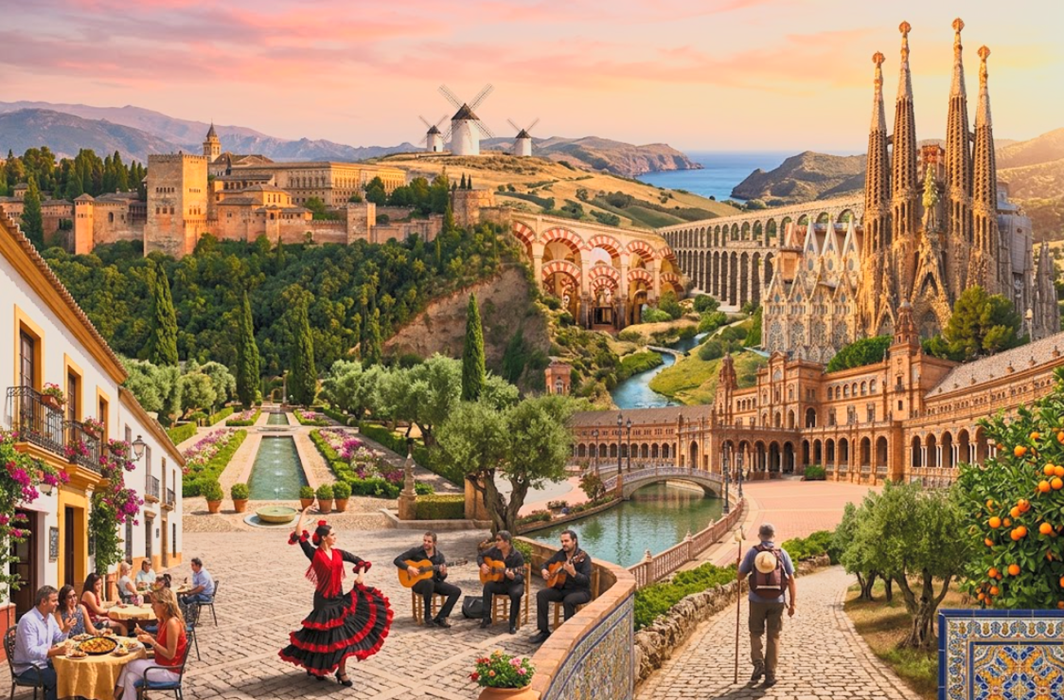
Spanish history is an epic tale of conquests, cultural blending, and rebirths. Even before becoming the nation we know today, this territory was walked by Phoenicians, Greeks, and Carthaginians. The Roman Empire then left an indelible mark, naming the region Hispania and building roads, aqueducts (like the one in Segovia), and theaters that are still admired today.
The major turning point in this history occurred in 711 with the arrival of the Moors. For nearly eight centuries, Al-Andalus shined through its scientific, philosophical, and architectural advancements. It was during this era that must-see masterpieces arose, such as the Alhambra in Granada or the Great Mosque of Córdoba, symbols of a complex yet fruitful coexistence between Muslims, Jews, and Christians.
The Reconquista, led by the Christian kingdoms of the north, ended in 1492 with the capture of Granada by the Catholic Monarchs, Isabella of Castile and Ferdinand of Aragon. That same year, Christopher Columbus discovered America, propelling the country into a Golden Age (El Siglo de Oro). The crown amassed immense wealth and experienced an unprecedented artistic and literary blooming, driven by geniuses like Miguel de Cervantes and Diego Velázquez. Closer to our time, the 20th century in Spain was marked by a devastating civil war and Franco’s dictatorship, before undergoing an exemplary democratic transition and rapid modernization in the 1980s.
Spanish Culture: Between Passion, Festivities, and the Art of Living
Culture in Spain is not just observed in museums; it is lived intensely on a daily basis. The pace of life here is famous for its shift compared to the rest of Europe. Meals are eaten late, the siesta (though less practiced in modern big cities) remains anchored in the collective imagination, and the evening often just begins at the hour when other countries go to sleep.
Flamenco is undeniably the most poignant cultural expression of the country. Born in Andalusia, this art combines heartbreaking singing (the cante), percussive guitar (the toque), and feverish dancing (the baile). It is the reflection of the gypsy soul, expressing profound pain as well as the purest joy.
Spaniards are also renowned for their love of popular festivals (fiestas). Every village and city celebrates its patron saint with unmatched fervor. The Semana Santa (Holy Week) transforms the streets into solemn and spectacular processions, particularly in Seville and Malaga. In Valencia, the Fallas illuminate the month of March with the burning of gigantic satirical sculptures, while Pamplona attracts the whole world for the thrills of the San Fermín.
On the artistic front, the country has produced giants of painting and architecture. Francisco de Goya captured the torments of his time, while the 20th century was revolutionized by Pablo Picasso, Salvador Dalí, and Joan Miró. In architecture, Antoni Gaudí’s Catalan modernism permanently changed the face of Barcelona, merging nature, religion, and structural innovation.
The Regions of Spain: A Country with Many Faces
Speaking of Spain in the singular is almost a geographical error. The country is divided into seventeen autonomous communities, each possessing its own identity, and sometimes its own language, traditions, and gastronomy.
Andalusia, in the south, often embodies the traditional image of the country: white villages perched on arid hills, endless olive groves, the cradle of flamenco and bullfighting. It is a region where the Moorish heritage is most visible, offering a sunny climate that attracts travelers all year round.
Catalonia, in the northeast, is a proud and distinct region, facing the Mediterranean. With its own language, Catalan, it claims a strong cultural identity, a dynamic entrepreneurial spirit, and an avant-garde architectural heritage.
The Basque Country (Euskadi), located in the north, is a land of striking contrasts. With its mysterious language (Euskera, the oldest in Europe), its wild coastlines battered by the Atlantic Ocean, and its lush green mountains, the Basque Country differs radically from the rest of the peninsula. It is also a premier gastronomic destination.
Galicia, located in the extreme northwest, surprises with landscapes reminiscent of Ireland or Brittany. It is a Celtic land, humid and bright green, known for its rías (inlets penetrating the land), its traditional bagpipe music, and its millennial pilgrimage to Santiago de Compostela.
The center of the country is dominated by Castile, the historical birthplace of the Spanish language (Castilian). It is a vast plateau of terracotta-colored lands, dotted with fortresses (the famous castillos that gave the region its name) and majestic medieval cities such as Toledo or Segovia.
Famous Cities and Must-Visit Places
To grasp the richness of this country, certain urban and historical stops are naturally essential.
Madrid, the capital, sits at the center of the peninsula. It is a vibrant city, renowned for its endless nights and art scene. The Golden Triangle of Art is a must, featuring the Prado Museum housing masterpieces by Velázquez and Goya, the Reina Sofía Museum where Picasso’s poignant Guernica is displayed, and the Thyssen-Bornemisza Museum. Retiro Park offers a monumental green escape in the heart of urban bustle.
Barcelona is the cosmopolitan and seaside rival. Strolling down the Ramblas or getting lost in the narrow streets of the Gothic Quarter is a sheer pleasure. But Barcelona is inseparable from Antoni Gaudí. The Sagrada Familia, an unfinished basilica whose towers defy the sky, Park Güell with its colorful mosaics, and Casa Batlló are marvels of originality that must be seen at least once in a lifetime.
Heading south, Seville enchants with its Andalusian charm. The Alcázar palace, a true jewel of Mudéjar architecture surrounded by lush gardens, and the immense Gothic cathedral topped by the Giralda (the former minaret) testify to its rich past. The Plaza de España, a masterpiece of ceramics and brick, is one of the most spectacular squares in the country.
In Granada, the majesty of the Alhambra dominates the city, set against the backdrop of the Sierra Nevada peaks. This Islamic palatial complex, with its soothing courtyards, water features, and lacelike carved stucco, represents the pinnacle of Nasrid art.
On the east coast, Valencia successfully weds a charming historical center with resolutely futuristic architecture in its City of Arts and Sciences, designed by architect Santiago Calatrava.
Finally, Córdoba is home to a monument unique in the world: the Mosque-Cathedral (Mezquita). Walking through this forest of jasper, marble, and granite columns, topped with two-toned arches, offers an unforgettable visual and spiritual experience, telling the region’s historical upheavals all on its own.
Gastronomy: A Feast for the Senses
Traveling in the Iberian Peninsula necessarily means embarking on a culinary exploration. Spanish gastronomy, based on fresh produce, olive oil, garlic, and herbs, is of exceptional variety.
The tradition of tapas is the quintessential culinary institution. It is not just a way of eating; it is a social ritual. Moving from bar to bar (ir de tapas) allows you to taste small, convivial portions: patatas bravas (fried potatoes in a spicy sauce), creamy ham croquetas, pulpo a la gallega (octopus sprinkled with paprika), or fried calamari.
The most internationally famous dish remains Paella. Originating in Valencia, true Valencian paella is prepared with rice, rabbit, chicken, green beans, and local white beans, without any seafood. Seafood or mixed variations have, however, become popularized along all the country’s coasts.
Meat lovers revere Jamón Ibérico, and more specifically Pata Negra. Coming from Iberian pigs fed exclusively on acorns (bellotas), this cured ham offers a melting texture and unparalleled nutty aromas.
The Tortilla de patatas, a thick potato omelet, is the ultimate comfort food, the subject of a constant national debate over whether it should be prepared with or without onions. In the south, to combat the summer heat, Gazpacho and Salmorejo (cold soups made from sun-drenched tomatoes, olive oil, and bread) are indispensable.
For a sweet touch, it is impossible to skip Churros con chocolate, long ridged fritters dipped in a cup of extremely thick hot chocolate, often enjoyed in the early morning after a long night of partying.
In short, exploring this country is not just about ticking off a list of monuments. It is about immersing yourself in a different rhythm, embracing a dense history, and savoring every moment. Whether you wish to lose yourself in the avant-garde architecture of Catalonia, listen to the Andalusian guitar resonate in the night, or share a seafood feast on the coasts of Galicia, Spain promises a sensory and memorable journey that inevitably leaves you wanting to return.

 EXPLORE
 EXPLORE
 EXPLORE
 EXPLORE