
 EXPLORE
Tourism in Morocco: Between Millennial History, Cultural Treasures, and Contemporary Growth
Morocco has fascinated travelers for centuries. As a unique geopolitical and cultural crossroads between Africa, Europe, and the Middle East, the Cherifian Kingdom has established itself today as an essential tourist destination. Far from being limited to postcard landscapes, traveling through Morocco is a true immersion through time. From ancient ruins to labyrinthine medieval medinas, and through a vibrant and booming cultural scene, discover why Moroccan tourism attracts a record number of travelers in search of authenticity and meaning.
The Roots of History: From Roman Antiquity to Imperial Dynasties
To understand the richness of the places to visit, one must dive deep into Morocco’s history. The territory has witnessed the succession of flourishing civilizations whose architectural and spiritual footprints remain intact.
Volubilis and the Ancient Foundation
Long before the rise of the great Islamic dynasties, the archaeological site of Volubilis, located at the foot of the Zerhoun massif, bore witness to the Roman presence. As the former capital of Mauretania Tingitana, this ancient city houses remarkable remains: a triumphal arch, temples, and above all, floors paved with sumptuous mosaics depicting mythological scenes. Volubilis embodies the starting point of the country’s organized urban history, later connected to the foundations established by Idriss I in Moulay Idriss and Fes, marking the birth of the first Moroccan state.
The Imperial Cities: Fes, Marrakech, Meknes, and Rabat
The beating heart of Morocco’s historical heritage lies in its imperial cities, each having taken a turn as capital under the impetus of prestigious dynasties (Almoravids, Almohads, Merinids, Saadians, Alaouites):
- Fes, the Spiritual Capital: Founded in the 9th century, the medina of Fes (Fes el-Bali) is one of the largest medieval cities in the world. It is home to the University of Al Quaraouiyine, founded in 859 and recognized by UNESCO and the Guinness World Records as the oldest continuously operating institution of higher learning in the world. Strolling through its 9,500 alleys inevitably leads to the famous traditional Chouara tanneries, an ancestral spectacle frozen in time.
- Marrakech, the Red City: Founded in the 11th century by the Almoravids, Marrakech has long been a major caravan crossroads. The famous Jemaa el-Fna square, a true open-air theater, preserves oral traditions, storytelling, and popular cuisine inscribed on UNESCO’s intangible cultural heritage list. The ochre pisé ramparts, the superb Menara Gardens, and the Bahia Palace illustrate the pinnacle of Arab-Andalusian art.
- Meknes, the Monumental: Built in the 17th century by the powerful Sultan Moulay Ismail, Meknes impresses with its massive walls stretching over 40 kilometers and its sumptuous Bab Mansour gate, a masterpiece of Moroccan architecture.
- Rabat, the Modern and Historic Capital: Between the Hassan Tower, the Mohammed V Mausoleum, and the Kasbah of the Udayas overlooking the Atlantic Ocean, Rabat brilliantly harmonizes its rich Almohad heritage with contemporary urban planning praised by UNESCO.
Must-See Destinations: A Mosaic of Landscapes and Traditions
Moroccan tourism stands out for its great geographical and cultural diversity. Each region offers a different facet of the Moroccan soul.
The Pearls of the Atlas and the Coast
- Chefchaouen, the Blue Pearl: Nestled in the Rif Mountains, this city captivates visitors with its streets and facades painted entirely in various shades of blue, offering an atmosphere of absolute tranquility.
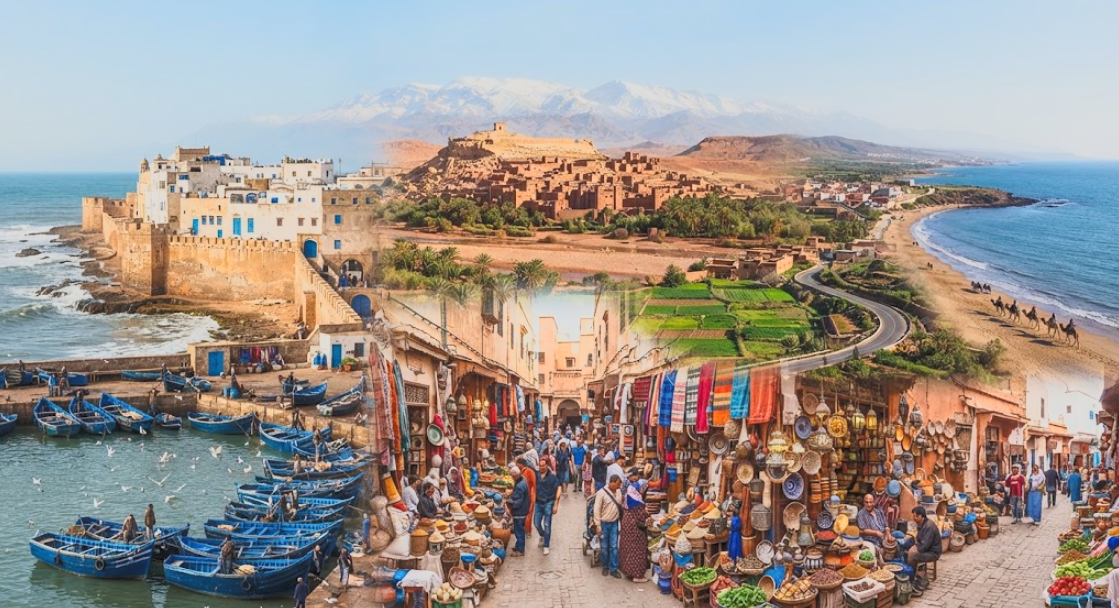
- Essaouira (Mogador): A former fortified port city built by the Portuguese on the Atlantic coast, Essaouira blends Berber, Arab, Jewish, and European influences. Its trade-wind-swept ramparts, fishing port with blue boats, and thuya wood artisans make it an essential cultural haven.
- The South and its Ksour: Following the Road of a Thousand Kasbahs to the south, the Ksar of Ait-ben-Haddou stands as an architectural marvel made of pisé, listed as a UNESCO World Heritage site and famous for serving as a backdrop for numerous Hollywood blockbusters. Further on, the majestic dunes of Erg Chebbi in Merzouga immerse travelers in the timeless magic of the Sahara and nomadic culture.
Contemporary Cultural Development: A Bridge Between Tradition and Modernity
Far from relying solely on its glorious past, Morocco is experiencing a dynamic cultural boom that is redefining its tourist appeal. The country is banking on contemporary creation to assert itself as an international artistic hub.
The Renaissance of Museums and Contemporary Art
In recent years, the Moroccan cultural landscape has gained top-tier infrastructure. In Rabat, the Mohammed VI Museum of Modern and Contemporary Art paved the way for increased visibility for Moroccan and African visual artists. In Marrakech, the famous Yves Saint Laurent Museum and the MACAAL (African Contemporary Art Museum Al Maaden) demonstrate the Red City’s appeal to creators from around the world. Contemporary art fairs and international music festivals (such as Mawazine in Rabat or the Gnaoua Festival in Essaouira) attract a cosmopolitan audience seeking cultural exchange.
Craftsmanship and Design: A Sustainable Creative Economy
Morocco’s cultural development also involves preserving and reinventing its craftsmanship. Master artisans (maalems), whether weavers, potters, coppersmiths, or leatherworkers, work hand in hand with contemporary designers to export a modern Moroccan art of living. This enhancement of ancestral know-how is part of a sustainable tourism approach, where every object purchased in the medina tells a human and local story.
Gastronomy and the Art of Living
Ranked among the richest in the world, Moroccan cuisine—a subtle fusion of Berber, Arab, Andalusian, and Mediterranean influences—enjoys exceptional promotion. Culinary experiences, ranging from fine dining in restored riads to street food stalls in Jemaa el-Fna square, form a central pillar of the tourist experience.
Overview and Prospects of a Booming Tourism Sector
Driven by this perfect alchemy between historical preservation and cultural dynamism, the Moroccan tourism sector is breaking all-time records. By surpassing the milestone of 19.8 million visitors, the Kingdom confirms its status as a leading continental tourism destination.
Traveling to Morocco today is much more than just a vacation: it is an intimate encounter with a living, millennial civilization—a journey where every stone, every song, every artisan, and every landscape tells the grand story of a country looking toward the future while honoring its roots.

 EXPLORE
 EXPLORE
 EXPLORE
 EXPLORE