
 EXPLORE
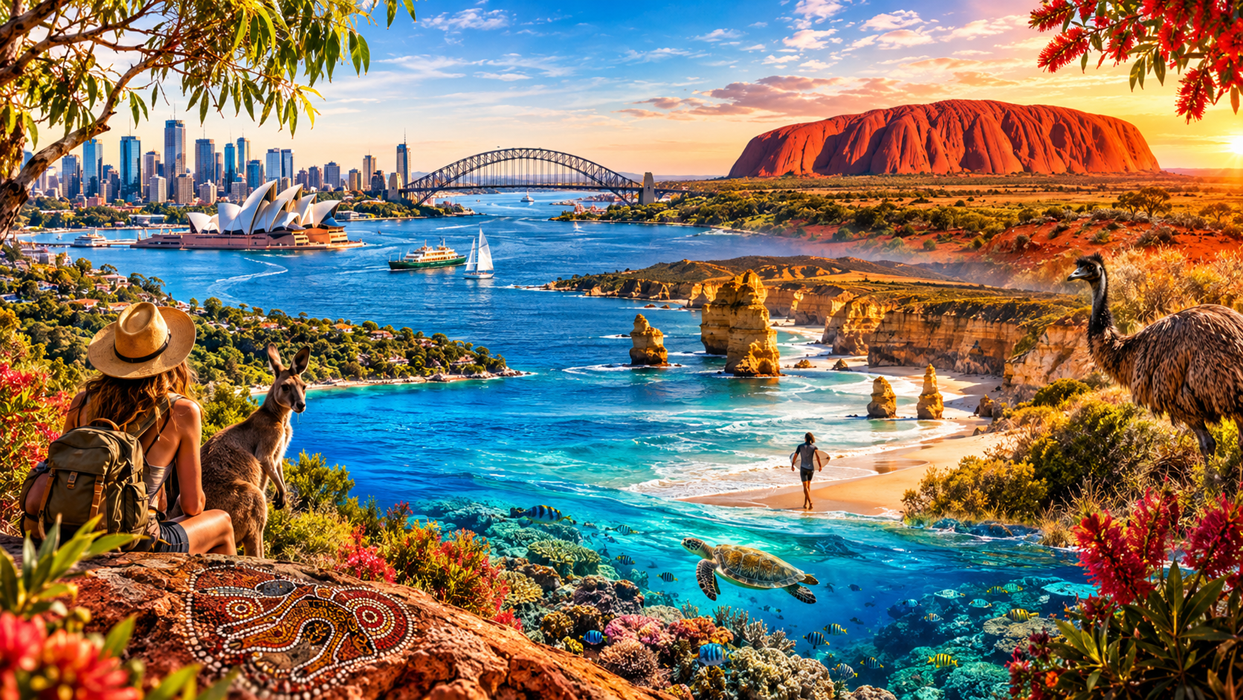
Australia is not merely a destination; it is an untamed continent, a colossal expanse of contrasting landscapes, and a vibrant mosaic of ancient traditions and modern dynamism. From the coral-fringed coastlines of Queensland to the ochre-dusted heart of the Outback, and from the misty peaks of Tasmania to the cosmopolitan buzz of its coastal metropolises, Australia defies simple definition. It is a land where you can ski down snow-capped mountains in the morning and surf world-class waves by the afternoon.
To travel to Australia is to accept an invitation to step outside the ordinary. It requires a willingness to embrace vast distances, a rugged environment, and a remarkably welcoming local spirit. This guide will navigate you through the historical roots, the cultural tapestry, the complex seasonality, and the magnetic urban centers of the land Down Under, ensuring your journey is as profound as the landscape itself.
A Tapestry of Time: The History of Australia
To understand Australia, one must first look back through the mists of time, long before European sails appeared on the horizon. Australia is home to the world’s oldest continuous living culture. For at least 65,000 years, Aboriginal and Torres Strait Islander peoples have been the custodians of this land. Their history is not recorded in dusty tomes but is woven into the very fabric of the continent—in ancient rock art galleries hidden in the Kimberley, in the creation stories of the Dreamtime that explain the formation of rivers and ranges, and in a profound, spiritual connection to the environment that endures to this day. Recognizing and respecting this ancient heritage is the first step in any meaningful Australian journey.
The trajectory of the continent shifted dramatically in the late 18th century. While various European explorers, including the Dutch and the French, had charted parts of the coast, it was the British who laid claim to the eastern seaboard in 1770 through Lieutenant James Cook. In 1788, the First Fleet arrived in Sydney Cove, transforming the ancient landscape into a British penal colony. The early years of European settlement were marked by severe hardship, conflict with and marginalization of the Indigenous populations, and a brutal struggle to tame a harsh, unfamiliar environment.
However, the discovery of gold in the 1850s changed everything. The gold rushes brought a massive influx of free settlers, fortune seekers, and prospectors from across the globe, particularly from Europe and China. This rapid population boom catalyzed the development of infrastructure, fueled the growth of spectacular Victorian-era cities like Melbourne, and sowed the seeds of a wealthy, multicultural society. In 1901, the various colonies federated to form the Commonwealth of Australia, birthing a new nation that has since evolved into a prosperous, democratic, and globally connected powerhouse.
The Heartbeat of the Land: Australian Culture
If Australia’s history provides its foundation, its culture provides its pulse. Australian culture is often stereotyped as a perpetual beach barbecue, and while there is some truth to the love of outdoor grilling and ocean swims, the reality is far more nuanced and cosmopolitan.
At the core of the Australian ethos is the concept of « mateship. » Born out of the necessity to rely on one another in a harsh, pioneering environment, mateship emphasizes equality, loyalty, and a fiercely egalitarian spirit. This translates into a famously laid-back, informal approach to life, perfectly encapsulated in the national catchphrase, « No worries. » This does not imply a lack of ambition, but rather a deeply ingrained belief that most problems can be overcome with a bit of humor and mutual support.
Modern Australia is one of the most successful multicultural societies on earth. Decades of post-war immigration from Europe, Asia, the Middle East, and beyond have irrevocably transformed the cultural landscape. Nowhere is this more evident than on the Australian plate. The culinary scene is a spectacular fusion of global influences. You are just as likely to find authentic Vietnamese pho, regional Italian pasta, and fiery Sichuan hotpot as you are a traditional meat pie. Furthermore, Australia’s coastal bounty means the seafood is unparalleled, and its burgeoning agricultural sector produces world-class beef, dairy, and organic produce.
The arts and sports are the twin pillars of Australian leisure. The country punches well above its weight in literature, cinema, and the performing arts, with thriving indigenous art movements drawing international acclaim. Simultaneously, sports are akin to a religion. Whether it is cricket in the summer, Australian Rules Football (AFL) or Rugby in the winter, or surfing year-round, athletic pursuits unite the nation, filling stadiums and dominating weekend conversations.
Chasing the Sun: Seasonality and When to Visit
Because Australia is roughly the size of the contiguous United States, treating its weather as a single entity is a recipe for a ruined vacation. The continent spans multiple climatic zones, meaning the « best » time to visit depends entirely on where you want to go and what you want to do. Remember, being in the Southern Hemisphere, the seasons are flipped: summer is December to February, and winter is June to August.
The Temperate South (Sydney, Melbourne, Adelaide, Tasmania) The southern half of the country experiences traditional four-season weather.
- Summer (December – February): This is peak beach season. The weather is hot, the days are long, and the coastal cities are buzzing with festivals and outdoor events. However, it can also be the most crowded and expensive time to visit, and inland temperatures can soar to uncomfortable extremes.
- Autumn (March – May): Widely considered one of the best times to explore the south. The blistering heat of summer subsides, replaced by clear, golden days and crisp evenings. It is the perfect season for wine tasting in the Barossa Valley or hiking in Tasmania.
- Winter (June – August): Winters are generally mild compared to North America or Europe. While Melbourne and Tasmania can be chilly and damp, Sydney often enjoys crisp, sunny days. This is the time to head to the Australian Alps for skiing, or to the coast for spectacular whale watching as humpbacks migrate north.
- Spring (September – November): A beautiful time of renewal. Wildflowers bloom across the countryside, temperatures warm up beautifully, and the wildlife is highly active.
The Tropical North (Cairns, Darwin, The Kimberley, Broome) The top end of Australia ignores the traditional four seasons, operating instead on a two-season tropical cycle.
- The Dry Season (May – October): This is the ultimate time to visit the tropics. The humidity drops, the skies are an endless, piercing blue, and the temperatures are balmy and comfortable. This is peak season for diving the Great Barrier Reef, exploring the Daintree Rainforest, or road-tripping through the rugged Kimberley region.
- The Wet Season (November – April): Often referred to locally as the « Green Season, » this period brings intense heat, oppressive humidity, and spectacular tropical monsoons. While many rural roads flood and some tour operators close, the landscape transforms into a vibrant, lush paradise, and the waterfalls are at their most thunderous.
The Arid Centre (Uluru, Alice Springs) The Outback is a land of extremes. Summer in the Red Centre is dangerously hot, with daytime temperatures regularly exceeding 40°C (104°F). It is generally advised to avoid central Australia during these months. The best time to visit the Outback is during the cooler months of May to September, when the days are pleasantly warm and the nights are remarkably cold, offering some of the best stargazing on the planet.
Urban Marvels: The Great Attractive Cities
Australia is a highly urbanized country, with the vast majority of its population clinging to the fertile fringes of the continent. Its capital cities are not just economic hubs; they are distinct personalities, each offering a unique flavor of Australian life.
Sydney: The Glamorous Icon
Sydney is the glittering jewel in Australia’s crown, a city where urban sophistication meets raw natural beauty. Built around one of the most stunning natural harbors in the world, Sydney commands attention. The sails of the Sydney Opera House and the steel arch of the Harbour Bridge form an instantly recognizable skyline. But beyond the postcards, Sydney is a city of distinct villages. You can spend your morning surfing the iconic breaks of Bondi Beach, your afternoon exploring the historic cobblestone alleyways of The Rocks, and your evening dining at world-class restaurants in Surry Hills or Barangaroo. It is fast-paced, fiercely beautiful, and deeply obsessed with the water.
Melbourne: The Cultural Capital
If Sydney is the glamorous older sibling, Melbourne is the cool, artistic, and slightly bohemian counterpart. Consistently ranked among the world’s most livable cities, Melbourne reveals its charms slowly. It is a city of hidden laneways adorned with world-class street art, subterranean cocktail bars, and an absolute obsession with specialty coffee. Melbourne is the undisputed cultural and sporting capital of the country. It hosts the Australian Open tennis, the Formula 1 Grand Prix, and boasts a theater and live music scene that rivals London or New York. The architecture is a fascinating mix of grand Victorian-era gold-rush buildings and cutting-edge modern design.
Brisbane: The Sun-Drenched River City
Heading north into Queensland, the pace slows down, and the temperature rises. Brisbane, affectionately known as « Brissy, » is a rapidly maturing metropolis that beautifully balances urban energy with a relaxed, subtropical lifestyle. The city curves along the banks of the winding Brisbane River, which serves as the central artery for transportation and recreation. The South Bank precinct offers lush parklands, man-made city beaches, and premier art galleries. Brisbane is optimistic, outdoorsy, and serves as the perfect jumping-off point for exploring the Gold Coast beaches to the south, or the ancient rainforests and the Great Barrier Reef further north.
Perth: The Isolated Beauty
Perth holds the unique title of being the most geographically isolated major city on earth. Nestled on the western edge of the continent, it is closer to Jakarta than it is to Sydney. This isolation has bred a fierce independence and a remarkably relaxed, affluent lifestyle fueled by the state’s mining wealth. Perth boasts more days of sunshine than any other Australian capital, making its pristine, uncrowded beaches—like Cottesloe and Scarborough—the center of local life. The nearby historic port town of Fremantle offers a bohemian counterpoint with its Victorian architecture, craft breweries, and bustling markets, while a short ferry ride takes you to Rottnest Island, home to the smiling, selfie-loving quokkas.
Adelaide: The Boutique Capital
Often overlooked by international visitors rushing between the east coast and the outback, Adelaide is Australia’s best-kept secret. It is a city of elegance, encircled by lush parklands and rolling hills. Adelaide is globally renowned for its access to world-class wine regions; the Barossa Valley, McLaren Vale, and the Clare Valley are all within an hour’s drive, offering some of the finest Shiraz and Riesling on the planet. Furthermore, Adelaide is known as the « City of Churches » and the « Festival City, » coming wildly alive during the late summer months when it hosts a flurry of international arts, comedy, and music festivals that rival the Edinburgh Fringe.
A Final Thought
Australia is a destination that demands time, energy, and an open heart. It is a place where you can lose yourself in the endless horizons of the Outback, find yourself in the bustling laneways of its modern cities, and connect with a culture that spans the entirety of human history. Whether you are seeking high-octane adventure, culinary excellence, or simply a quiet patch of pristine white sand, the sunburnt country offers a boundless charm that stays with you long after the journey ends.
 EXPLORE
 EXPLORE
 EXPLORE
 EXPLORE