
 EXPLORE
Scattered across nearly three million square kilometers in the heart of the western Pacific Ocean, the Federated States of Micronesia represent one of the last frontiers of global tourism. Comprising 607 islands divided into four distinct states — Yap, Chuuk, Pohnpei, and Kosrae — this Oceanian gem offers a timeless escape among turquoise lagoons, volcanic mountains carpeted in emerald jungle, and mysterious archaeological ruins. Far from the beaten paths of mass tourism, a trip to Micronesia promises an authentic adventure where nature reigns supreme and ancestral traditions still set the rhythm of daily life.
Why Visit Micronesia? The Appeal of an Extraordinary Destination
Choosing Micronesia for your next major trip means seeking exclusivity and a complete change of scenery. The number one reason travelers journey to this archipelago in the Caroline Islands is undoubtedly its world-class scuba diving. Whether you are passionate about marine biology, pristine coral reefs, or sunken military history, Micronesian waters rank among the most spectacular on the planet.
Beyond its crystal-clear waters, the country captivates visitors with its preserved authenticity. With only a few tens of thousands of visitors per year across the entire territory, you will often feel as though you are exploring a deserted island. Ecotourism here is not a mere marketing buzzword, but an everyday reality: hiking through primary rainforests dotted with towering waterfalls, kayaking through mangroves, or surfing uncrowded barrel waves in Pohnpei. Finally, the warm hospitality of local communities and the richness of their intangible heritage turn every stopover into a deeply human experience.
Main Cities and Islands of Micronesia: 4 States, 4 Identities
The political and cultural geography of the Federated States of Micronesia revolves around its four island states, whose urban centers resemble peaceful tropical towns rather than modern metropolises.
Palikir and Kolonia (State of Pohnpei)
Located on the main island of Pohnpei, the largest and highest in the federation, these two towns form the nerve center of the country. Palikir has served as the federal capital since 1989: nestled in a lush green valley, it houses government buildings whose architecture is inspired by traditional Micronesian structures. A few kilometers to the northeast, Kolonia remains the liveliest town and the true historical and commercial hub of the island. Visitors can still see traces of successive foreign administrations — Spanish stone walls, a German Catholic bell tower, and Japanese bunkers — while enjoying its small local markets, welcoming restaurants, and marina.
Weno (State of Chuuk)
Formerly known as Moen, the island of Weno serves as the capital of Chuuk State, the most populous in the federation. As the air and sea gateway to the vast Chuuk Lagoon, Weno is a bustling, contrasting town backed by verdant hills. It is the hub for dive centers and hotels welcoming enthusiasts from around the world, alongside several historical landmarks such as the old Japanese lighthouse overlooking the ocean.
Colonia (State of Yap)
Not to be confused with its namesake in Pohnpei, Colonia (spelled with a « C ») is the quiet capital of Yap State. Built around Tamil Bay, this human-scale town charms visitors with its peaceful atmosphere where modernity coexists with fierce traditionalism. Its streets lined with tropical vegetation lead to thatched-roof community houses and docks where wooden sailboats and dive boats float gently.
Tofol and Lelu (State of Kosrae)
At the eastern edge of the archipelago, Kosrae is a wild volcanic island nicknamed the « Jewel of the Pacific. » Tofol serves as its administrative center, while the islet village of Lelu, connected to the mainland by a causeway, forms the historical and cultural heart of the island. Here, there is no urban bustle: life flows at the pace of the tides and lush surrounding nature.
Must-See Places and Top Attractions
Each Micronesian state holds unique treasures that alone justify making the journey across the Pacific.
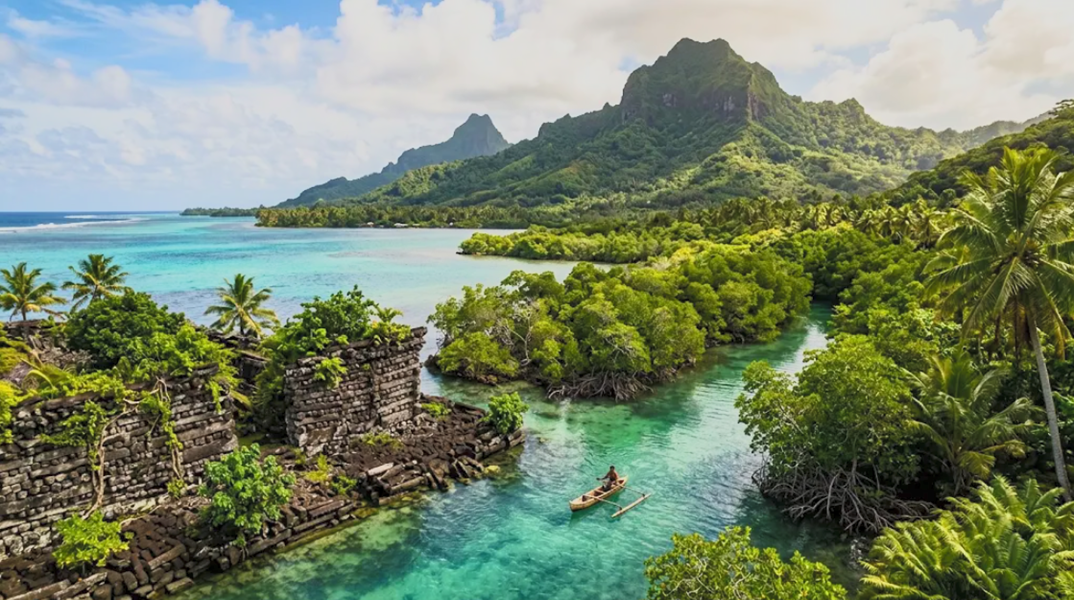
- The Ruins of Nan Madol (Pohnpei): Listed as a UNESCO World Heritage Site, this exceptional archaeological complex is often called the « Venice of the Pacific. » Built between the 12th and 17th centuries atop a coral reef, this ceremonial city consists of nearly one hundred artificial islets constructed from gigantic prismatic basalt columns. Navigating its mangrove-lined canals at high tide immerses visitors in the mystery of the ancient Saudeleur dynasty.
- Chuuk Lagoon (Truk Lagoon): A true Mecca for divers, this immense lagoon holds the largest ghost fleet in the world. In February 1944, during Operation Hailstone, dozens of Japanese warships, cargo vessels, and aircraft were sunk here. Today, these wrecks resting at depths between 10 and 60 meters are covered in an astonishing profusion of soft corals, sponges, and sea fans, forming a poignant underwater museum inhabited by reef sharks and schools of barracudas.
- The Stone Money Banks of Yap: The island of Yap is world-famous for its Rai stones, massive carved calcite disks that can reach three meters in diameter and weigh several tons. Quarried centuries ago on the islands of Palau hundreds of kilometers away and brought back by canoe at the peril of navigators’ lives, these disks are lined up along village pathways (mangal). A stone’s value depends on its history rather than physical possession, with ownership transferred orally. Yap is also a premier sanctuary for swimming alongside impressive resident manta rays.
- Kepirohi Waterfall and Sokehs Rock (Pohnpei): Beyond Nan Madol, Pohnpei’s natural landscape offers striking panoramas. Kepirohi Waterfall unleashes a twenty-meter-high curtain of water over a wall of natural basalt columns, carving out a pool ideal for swimming. Further north, climbing Sokehs Rock rewards hikers with sweeping views over the lagoon, the town of Kolonia, and the barrier reef.
- The Ruins of Lelu and Utwe Marine Park (Kosrae): Similar to Nan Madol but built on dry land between the 13th and 14th centuries, the basalt ruins of Lelu bear witness to a sophisticated ancient feudal society. On the southern end of the island, the Utwe-Walung Biosphere Reserve allows visitors to glide by canoe through a cathedral-like mangrove forest of absolute serenity.
Culture and Traditions: A Vibrant Oceanian Heritage
Although English serves as the official language uniting the federation, Micronesia is a fascinating cultural mosaic where no fewer than eight major indigenous languages are spoken (Pohnpeian, Chuukese, Yapese, Kosraean, as well as Polynesian languages on the isolated atolls of Nukuoro and Kapingamarangi).
Micronesian society is built on a clan-based and often matrilineal structure, in which lineage, social status, and land rights are passed down through women. The extended family and respect for traditional chiefs remain the pillars of community life. On the island of Yap, this devotion to custom is particularly visible: men’s houses (faluw) and community meeting houses (pebaey), masterpieces of carpentry lashed together exclusively with coconut fiber rope, still dominate the villages. During ceremonies and festivals, captivating traditional dances — performed by men wearing colorful loincloths (thu) and women adorned in hibiscus-fiber skirts — recount founding myths and ancestral exploits.
Another jewel of Micronesian heritage lies in the art of traditional navigation. Long before modern instruments, master navigators from the outer islands of Yap and Chuuk crossed thousands of kilometers of open ocean aboard outrigger canoes carved from breadfruit trunks, finding their way solely by reading the stars, ocean swells, and flight patterns of birds. Finally, in Pohnpei, social life centers each evening around the ritual of Sakau (a cousin of Oceanian kava): wild pepper roots are rhythmically pounded on large flat stones whose ringing echoes through the jungle, before being squeezed through hibiscus bark to yield a soothing drink shared with respect.
History and Development: Between Traditions and 21st-Century Challenges
To understand contemporary Micronesia, one must look at its eventful history. Settled more than three thousand years ago by Austronesian navigators, the Caroline Islands experienced four successive foreign administrations: Spanish colonization in the 17th century, Germany’s purchase of the islands in 1899 to develop the copra trade, Japanese occupation starting in 1914 marked by fierce World War II battles, and American administration under a UN mandate from 1945 onward.
Independent since 1986, the Federated States of Micronesia is linked to the United States through a Compact of Free Association. This strategic partnership explains why the US dollar (USD) is the country’s official currency and why American financial assistance supports much of its public infrastructure, education, and healthcare.
The archipelago’s economic development relies primarily on subsistence agriculture, niche tourism, and above all the sale of tuna fishing rights within its vast exclusive economic zone. Acutely aware of its vulnerability to climate change and rising sea levels — which directly threaten its low-lying coral atolls — Micronesia stands on the international stage as a vocal advocate for environmental protection. The nation pursues sustainable development focused on marine conservation, renewable energy, and low-impact tourism, ensuring the preservation of its ecosystems for future generations.
Micronesian Gastronomy: Flavors of the Land and Ocean
Cuisine in Micronesia directly reflects its generous geography and history: simple, ultra-fresh, and centered on bounty from the sea and tropical forest.
The staple ingredient of the Micronesian table is breadfruit (uru), accompanied by taro, yams, and a wide variety of plantains. These starches are traditionally slow-cooked in an earth oven lined with white-hot volcanic stones (uhm), and often drizzled with freshly pressed coconut milk.
From the sea, fish-rich waters yield daily catches of yellowfin tuna, mahi-mahi, wahoo, grouper, as well as mangrove crabs and spiny lobsters. Thanks to historical Japanese influence, fresh tuna sashimi, served with soy sauce, wasabi, and local lime (especially prized in Kosrae for its fragrant sweetness), is a staple starter in restaurants across the archipelago.
Curious food lovers should not miss tasting Pohnpei black pepper, regarded by gourmets as among the finest in the world for its woody, pungent notes. It elevates both grilled fish and marinated meats. To end a meal on a sweet note, nothing beats fresh papaya, juicy mangoes, sun-ripened pineapple, or a freshly picked green coconut.
Practical Tips for a Successful Trip to Micronesia
Planning an expedition to Micronesia requires a bit of preparation. The climate is tropical, warm, and humid year-round, with temperatures hovering pleasantly between 26 °C and 30 °C (79 °F to 86 °F) both on land and in the water. The ideal time to visit most of the islands runs from December to April, when trade winds blow and humidity is lower, though diving and hiking remain possible throughout the year.
To reach this remote paradise, the classic route takes the famous United Airlines « Island Hopper » flight, which connects Honolulu (Hawaii) to Guam with stops in Majuro, Kwajalein, Kosrae, Pohnpei, and Chuuk. Another option is transiting through Asia (Manila or Tokyo) to Guam before flying onward to Yap or the other states. Once there, carry US dollar cash for expenses in remote villages, dress modestly outside hotel resorts in respect of local customs (particularly in Yap and Kosrae, where shoulders and knees should remain covered when visiting villages), and let yourself be carried away by the unspoiled magic of Oceania.

 Acheter sur Amazon FR
 FOOD
 EXPLORE
 EXPLORE