
 EXPLORE
From the moment you set foot on Egyptian soil, a sense of temporal vertigo takes hold. Egypt is not merely a tourist destination; it is a pilgrimage to the very origins of humanity. From the untamed energy of Cairo to the golden serenity of the Nile’s banks, every grain of sand seems to whisper the legends of a glorious past. This fascinating country, a true crossroads between Africa and the Orient, has for centuries attracted archaeologists, dreamers, and travelers in search of wonder.
A trip to Egypt is a total immersion into a civilization that has defied time. The colossal architecture, complex beliefs, and today’s vibrant culture form a striking kaleidoscope. Whether you wish to decipher hieroglyphs carved in the twilight of tombs, sail to the slow rhythm of a felucca, or lose yourself in the spicy aromas of traditional souks, Egypt promises an absolute adventure. Let us dive together into the secrets of this millennial land.
The Legacy of the Pharaohs: A History Forged in Stone
The history of ancient Egypt spans over three millennia, a prodigious longevity that rests on an unshakable political and religious organization. At the top of this social pyramid stood the pharaoh, much more than a simple sovereign. The earthly incarnation of the god Horus, he was the guarantor of Ma’at, this fundamental concept designating harmony, justice, and cosmic balance. Without the pharaoh to repel chaos, Egyptians believed the world would collapse.
The Egyptian religion, with its abundant pantheon, dictated every aspect of daily life and, most importantly, death. Earthly life was perceived merely as a brief stage before eternity. This obsession with the afterlife gave rise to complex practices such as mummification, intended to preserve the physical vessel so that the soul (the Ka and the Ba) could reside there forever.
Legendary figures have sculpted this history. Khufu, the visionary builder; Hatshepsut, the audacious queen who had herself crowned pharaoh; Akhenaten, the heretic sovereign who attempted to impose the single worship of the Aten; and Ramses II, the builder monarch whose monumental ego scattered the country with temples to his own glory. Finally, how can we not mention Tutankhamun? Although his reign was brief and politically minor, the discovery of his intact tomb in 1922 by Howard Carter propelled him to the rank of the most famous pharaoh in modern history.
Must-See Sites: What to Visit in Egypt?
Cairo and the Giza Pyramids: Facing the Enormous
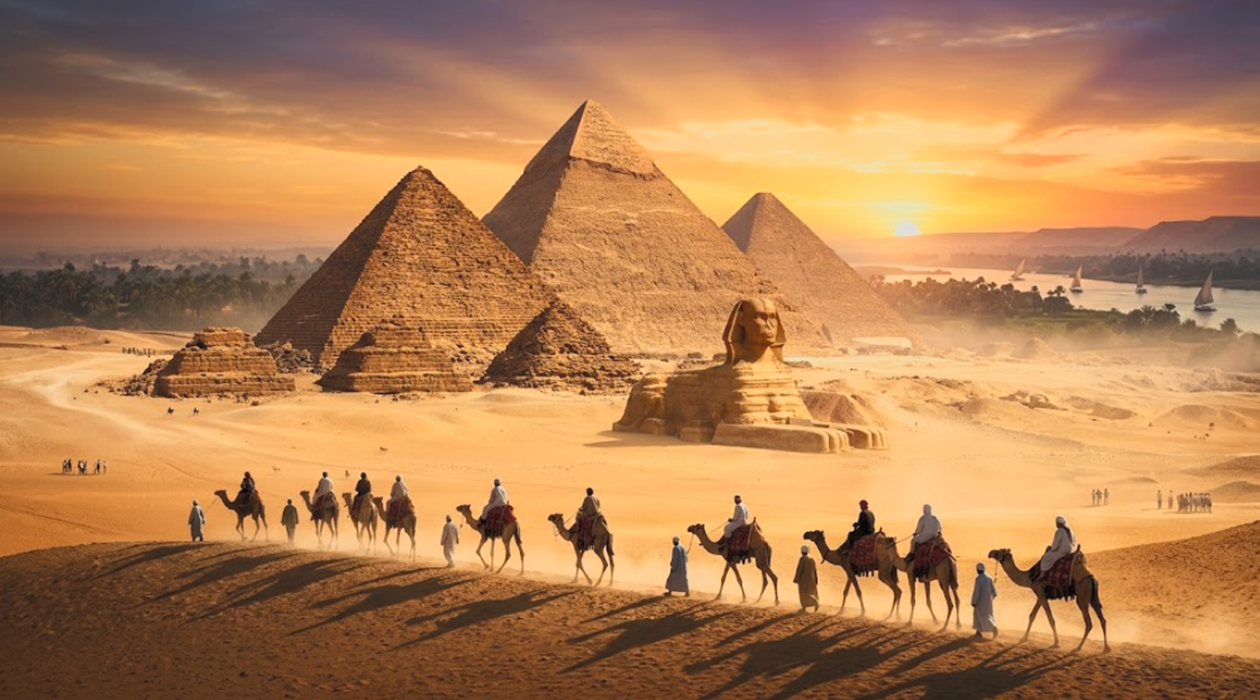
Cairo, a bustling megalopolis of over twenty million inhabitants, is a city that never sleeps. But it is on its outskirts, on the Giza plateau, that the greatest symbol of the country stands: the pyramids of Khufu, Khafre, and Menkaure.
The Great Pyramid of Khufu, the only wonder of the ancient world still standing, commands silent respect. Built over 4,500 years ago with more than two million blocks of stone, its architectural precision defies understanding. A few steps away, the Great Sphinx, a mythological creature with a lion’s body and a pharaoh’s head, stands guard with unsettling impassivity. A visit to Cairo would not be complete without exploring the Egyptian Museum, or the brand new Grand Egyptian Museum (GEM), a sumptuous showcase designed to house the entirety of Tutankhamun’s treasure.
Luxor: The Open-Air Museum of Antiquity
Formerly Thebes, the religious capital of the New Kingdom, Luxor concentrates an unparalleled density of archaeological remains. Divided by the Nile, the city symbolically separates the world of the living (the East Bank) from that of the dead (the West Bank).
On the East Bank, the Karnak complex is a visual shock. Its hypostyle hall, a veritable forest of 134 massive columns deeply engraved with hieroglyphs, gives the impression of wandering through a world of giants. Further south, the Luxor Temple, majestic at nightfall when illuminated, offers an enchanting walk in the heart of the modern city.
Crossing to the West Bank takes you to the mythical Valley of the Kings. It is in this mineral and arid landscape that the pharaohs had their secret tombs dug to escape looters. The underground frescoes, their colors still vibrant after millennia, illustrate the deceased’s perilous journey to the afterlife. Nearby, the mortuary temple of Hatshepsut at Deir el-Bahari, with its superimposed terraces blending into the limestone cliff, is a masterpiece of architectural integration.
Aswan and Abu Simbel: Majesty at the Edge of Nubia
Further south, the atmosphere changes. The Nile winds around black granite islands and ochre sand dunes. Aswan is the gateway to Nubia. The pace here is slower, the souks more fragrant, and Nubian culture displays its bright colors on house facades. This is where the Philae Temple rests, a romantic sanctuary dedicated to the goddess Isis, saved from the waters following the construction of the first dam.
But the most breathtaking excursion from Aswan remains Abu Simbel.
Carved directly into the mountain by Ramses II to intimidate his southern neighbors, the two temples were miraculously dismantled and rebuilt higher up in the 1960s by UNESCO to escape the rising waters of Lake Nasser. The ancient engineering was such that, twice a year, the sun’s rays penetrate to the back of the sanctuary to illuminate the divine statues, symbolically leaving the god of darkness, Ptah, in the shadows.
Alexandria: The Pearl of the Mediterranean
Founded by Alexander the Great, Alexandria offers a completely different face of pharaonic Egypt. Facing the sea and swept by Mediterranean winds, it breathes a Greco-Roman past and cosmopolitan nostalgia. Although the famous lighthouse (another wonder of the ancient world) has vanished, its location is now occupied by the imposing Qaitbay Citadel. The city shines once again through its Bibliotheca Alexandrina, a marvel of contemporary architecture that pays homage to the legendary ancient library destroyed by flames. Its catacombs of Kom el-Shoqafa illustrate a fascinating mix of Egyptian and Roman art, testifying to the cultural crossroads that shaped the city.
The Magic of the Nile: The Blood of Egypt
The Greek historian Herodotus claimed that « Egypt is the gift of the Nile. » This truth strikes every traveler. The river is the vital artery around which the entire civilization developed. Beyond the lush green banks, the hostile desert immediately reclaims its rights.
Taking a Nile cruise is an essential part of a successful trip. While large cruise ships offer modern comfort, it is aboard a felucca (a small traditional sailboat) or a dahabiya (a luxurious wooden sailing boat) that one grasps the true poetry of the river. Gliding silently on the water at sunset, watching farmers cultivate the banks as they did millennia ago, listening to the call of the muezzins echoing from distant villages: it is a pause suspended in time.
A Vibrant and Enchanting Culture
Visiting Egypt is also about meeting the Egyptians. The warmth of their welcome, their unfailing sense of humor, and their generosity leave a profound mark. Contemporary culture is experienced in the buzz of traditional cafes (ahwas), where men play backgammon while smoking apple-flavored shisha, lulled by the legendary voice of the singer Oum Kalthoum.
Craftsmanship abounds in the markets. The Khan el-Khalili souk in Cairo is a sensory labyrinth mingling spice merchants, goldsmiths, antique dealers, and leather artisans. Haggling is the golden rule here, a social dance paced by glasses of burning hot, sweet black tea with mint.
Egyptian cuisine, rich and hearty, is worth lingering over. The national dish is undoubtedly Koshary, a surprising but delicious mix of macaroni, rice, lentils, chickpeas, and fried onions, crowned with a spicy tomato sauce. In the morning, Egyptians eat Ful Medames (fava beans stewed with olive oil and cumin), served with fresh flatbread. Those with a sweet tooth will succumb to Om Ali, a rich bread pudding with milk, puff pastry, raisins, and pistachios.
The Unsolved Mysteries of Egyptian Antiquity
What makes Egypt so fascinating is the persistence of its mysteries. Despite centuries of excavation and the use of cutting-edge technology, the sand still hides countless secrets.
The construction of the Giza pyramids continues to divide Egyptologists and engineers. How could Bronze Age men, without wheels or complex pulleys, raise structures of such geometric perfection? Recent scientific missions, like the ScanPyramids project, have used muography (cosmic particle detection) to reveal the presence of gigantic secret cavities deep within the Great Pyramid, whose function remains a complete enigma.
Other mysteries fan the flames of passion: the tomb of the famous Queen Cleopatra has never been located, and that of the brilliant architect Imhotep remains elusive. As for the legendary « curse of the pharaohs, » popularized after the mysterious deaths following the opening of Tutankhamun’s tomb, it continues to feed literature and cinema, adding an aura of thrill to archaeological rigor.
Practical Advice for a Successful Trip to Egypt
To fully enjoy this exceptional destination, good preparation is essential.
- The best time to go: Favor the months from October to April. The Egyptian winter offers mild temperatures and an immaculate blue sky. From May to September, the heat in the south of the country (Luxor, Aswan) can become overwhelming and easily exceed 40°C.
- Formalities and visa: A tourist visa is required for most travelers. It is easily obtained online via the official e-Visa portal of the Egyptian government, or directly upon arrival at the airport.
- Dress code and respect: Egypt is a conservative country. For both men and women, it is recommended to wear loose clothing covering shoulders and knees out of respect for local culture. This will also effectively protect you from the blazing sun.
- Money and tipping: The local currency is the Egyptian Pound (EGP). The « baksheesh » (tipping) system is a deeply rooted institution in society. Always carry small bills with you to thank temple guards, drivers, or porters.
A journey across Egyptian lands leaves an indelible mark. It is a direct confrontation with the foundations of our human history. You never return quite the same after meeting the granite gaze of the pharaohs and feeling the hot desert wind on your face. Prepare to experience a majestic epic where every stone tells a legend, and where mystery reigns supreme.


 EXPLORE

 EXPLORE
 EXPLORE
 EXPLORE